Long before electricity was discovered, people needed help with math. Around 3,000 years ago, people in places like China and the Middle East used the abacus, a wooden frame with rows of sliding beads. By moving the beads back and forth, people could add, subtract, multiply, and divide large numbers quickly. The abacus was one of the earliest computing devices, and some people around the world still use it today.
Babbage and the First Computer Design
In the 1830s, a British mathematician named Charles Babbage designed a machine called the Analytical Engine. It was never fully built during his lifetime, but the design was far ahead of its time. It had many of the same basic ideas that modern computers use, including a way to store numbers in memory and follow step-by-step instructions. A mathematician named Ada Lovelace studied Babbage’s machine carefully and wrote detailed notes explaining how it could be programmed. Because of this work, Lovelace is often called the first computer programmer.
Room-Sized Computers
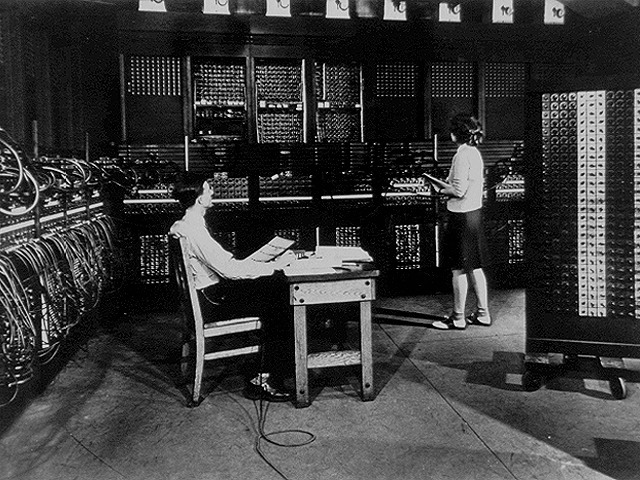
The first electronic computers appeared in the 1940s. One of the most famous was ENIAC, which stood for Electronic Numerical Integrator and Computer. Built at the University of Pennsylvania, ENIAC was completed in 1945 and weighed about 30 tons, roughly the weight of five elephants! It filled an entire room and used about 18,000 vacuum tubes, which were glass bulbs that controlled electrical signals. ENIAC could perform around 5,000 addition problems per second, which was very fast for its time but far slower than even a basic phone today.
The Personal Computer Revolution
For decades, computers were huge, expensive machines used only by governments, universities, and large companies. That began to change in the 1970s. In 1977, Steve Wozniak and Steve Jobs released the Apple II, one of the first personal computers designed for regular families. It could display color graphics and even play simple games. In 1981, IBM released its own Personal Computer, known as the IBM PC. It ran an operating system made by a young company called Microsoft. Suddenly, computers were showing up in homes, schools, and offices around the world.
Computers Today
Modern computers are millions of times more powerful than ENIAC, yet they fit in your pocket. A smartphone contains more computing power than all of NASA had when it sent astronauts to the Moon in 1969. Laptops, tablets, and smartwatches keep getting smaller, faster, and more capable every year. Computers help doctors diagnose diseases, help scientists explore space, and let people around the world talk to each other instantly.
Fun Facts
- The abacus has been used for over 3,000 years and is still used in some parts of the world today.
- Ada Lovelace, often called the first computer programmer, was the daughter of the famous poet Lord Byron.
- ENIAC used so much electricity that, according to popular legend, it dimmed the lights in an entire section of Philadelphia when it was turned on.
- The Apple II was one of the first personal computers to display color graphics, and it cost about $1,298 in 1977.
- Your smartphone is millions of times more powerful than the computers that guided the Apollo 11 mission to the Moon.
 OtterKnow Kids Encyclopedia