Designing and Building the Statue
Frederic Auguste Bartholdi designed the statue to look like Libertas, the Roman goddess of freedom. She holds a torch high in her right hand and carries a tablet in her left hand inscribed with the date July 4, 1776, in Roman numerals. Alexandre Gustave Eiffel, the same engineer who later built the Eiffel Tower in Paris, designed the iron framework inside the statue that holds it up. The outer skin is made of about 300 copper sheets, each about the thickness of two pennies stacked together. Workers in France built the statue in pieces, and it was displayed in Paris before being taken apart and shipped across the Atlantic Ocean.
Shipping and Assembly
The completed statue was disassembled into 350 individual pieces and packed into 214 wooden crates for the voyage to America. The pieces arrived in New York Harbor aboard the French ship Isere in June 1885. Meanwhile, Americans had been raising money to build the stone pedestal that the statue would stand on. Joseph Pulitzer, a famous newspaper publisher, helped raise over $100,000 from more than 120,000 donors, many of whom gave less than a dollar each. Workers reassembled the statue on its pedestal on Bedloe’s Island, and it was dedicated on October 28, 1886.
What the Statue Looks Like
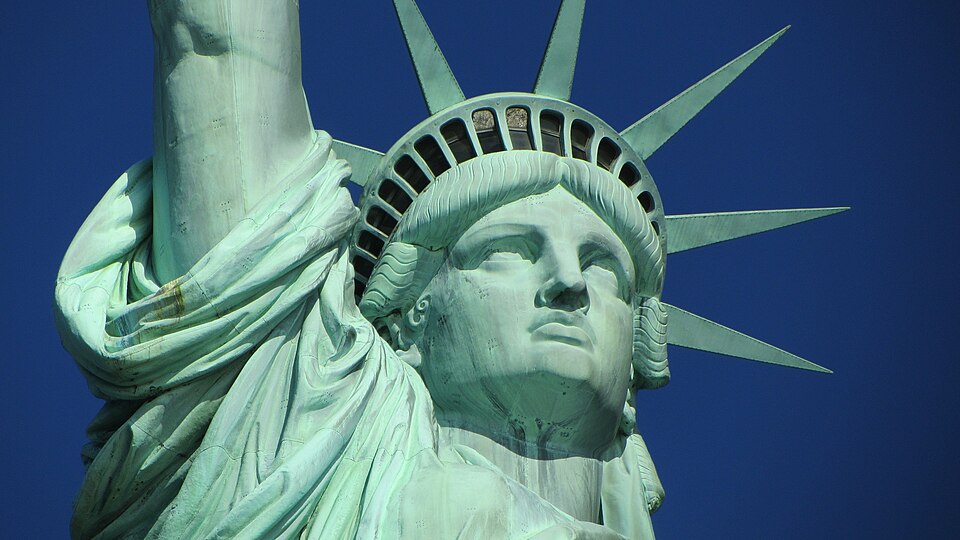
The Statue of Liberty stands 151 feet tall from her feet to the tip of her torch, and the pedestal adds another 154 feet, making the total height about 305 feet. Her copper skin was originally a shiny reddish-brown color, but over time it turned the green color we see today because of a natural process called oxidation. The statue’s crown has seven rays, which represent the seven continents and seven oceans of the world. There are 354 steps inside the statue to climb from the base to the crown. Her face alone is more than 8 feet tall, and each of her eyes is about 2.5 feet wide.
The Poem at the Base
In 1903, a bronze plaque was added to the pedestal bearing a famous poem called “The New Colossus” by Emma Lazarus. Lazarus had written the poem in 1883 to help raise money for the pedestal’s construction. The most famous lines read: “Give me your tired, your poor, your huddled masses yearning to breathe free.” These words captured the idea that America was a place of hope and opportunity for people coming from other countries. The poem helped transform the statue from a symbol of international friendship into a powerful symbol of welcome for immigrants arriving in the United States.
A Beacon for Immigrants
Between 1892 and 1954, more than 12 million immigrants entered the United States through the nearby Ellis Island immigration station. For many of these newcomers, the Statue of Liberty was the first thing they saw as their ships sailed into New York Harbor. Seeing the statue after a long and difficult ocean voyage filled many immigrants with hope and excitement about starting new lives. The statue became a symbol of the American dream and the promise of freedom and opportunity. Families who came through Ellis Island often passed down stories about the powerful moment they first glimpsed Lady Liberty.
Preservation and Restoration
Over the decades, the Statue of Liberty needed repairs to keep it standing strong. The most significant restoration took place from 1984 to 1986, when workers replaced the torch, repaired the iron framework, and cleaned the entire statue. President Ronald Reagan presided over a rededication ceremony on July 4, 1986, marking the statue’s 100th birthday. The statue was closed to visitors after the September 11, 2001, attacks for safety reasons and was reopened in stages over the following years. In 2012, Hurricane Sandy caused damage to Liberty Island’s infrastructure, leading to another round of repairs.
Visiting the Statue Today
The Statue of Liberty is one of the most visited landmarks in the United States, welcoming about 4 million visitors each year. It became a National Monument in 1924 and was designated a UNESCO World Heritage Site in 1984. Visitors can take a ferry from Manhattan or New Jersey to Liberty Island, where they can explore the museum, climb to the pedestal observation deck, or reserve special tickets to climb up into the crown. The Statue of Liberty Museum, which opened in 2019, features the statue’s original torch and interactive exhibits about its history. Lady Liberty continues to stand as one of the most recognized symbols of freedom and hope in the entire world.
 OtterKnow Kids Encyclopedia