Most black holes form when a very massive star runs out of fuel and dies in a giant explosion called a supernova. After the explosion blows the outer layers of the star into space, the core that remains collapses under its own gravity. If that core is heavy enough, roughly three times the mass of our Sun or more, it keeps collapsing until it becomes a black hole. The matter gets squeezed into a tiny point called a singularity. This process happens over millions of years as the star burns through its fuel before the final collapse takes just seconds.
Parts of a Black Hole
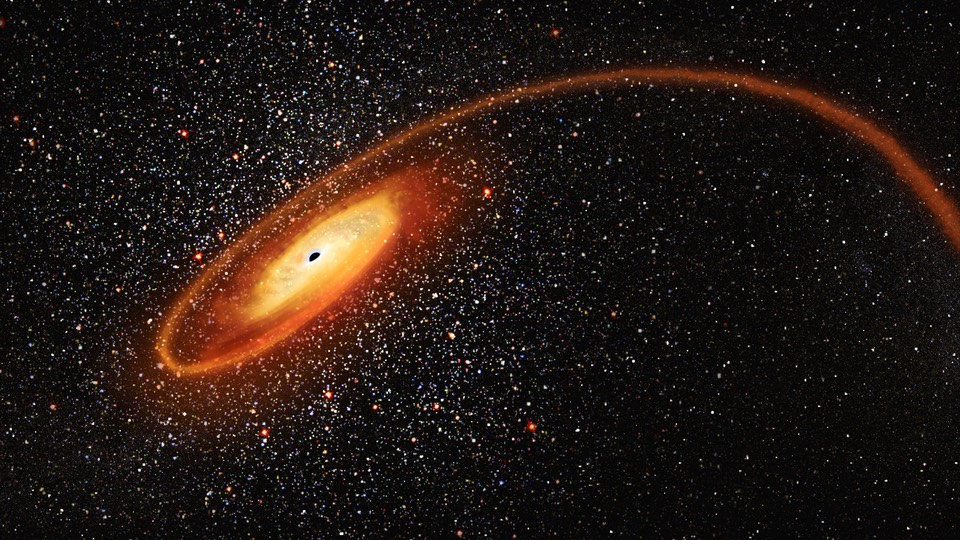
Every black hole has a boundary called the event horizon, which is the point of no return. Once anything crosses the event horizon, it can never come back out. At the very center of a black hole lies the singularity, where all the mass is crushed into an unimaginably small point. Around many black holes, there is a swirling disk of hot gas and dust called an accretion disk. The accretion disk can glow extremely brightly as material spirals inward and heats up to millions of degrees.
Types of Black Holes
Scientists have discovered three main types of black holes based on their size. Stellar black holes form from collapsed stars and are usually 5 to 100 times the mass of our Sun. Supermassive black holes sit at the centers of most galaxies and can be millions or even billions of times the mass of our Sun. The supermassive black hole at the center of our Milky Way galaxy is called Sagittarius A* and is about 4 million times the mass of the Sun. Scientists are still studying how supermassive black holes grew to be so enormous.
The First Photo of a Black Hole
In April 2019, scientists released the first-ever image of a black hole, which was a historic moment for astronomy. The picture was taken by the Event Horizon Telescope, which is actually a network of eight radio telescopes spread across the globe. They worked together to photograph a supermassive black hole at the center of a galaxy called M87, located about 55 million light-years from Earth. The image shows a bright orange ring of superheated gas surrounding a dark shadow in the center. In 2022, the same team released an image of Sagittarius A*, the black hole at the center of our own Milky Way galaxy.
What Happens Near a Black Hole
Strange things happen near a black hole because of its extreme gravity. Time actually slows down the closer you get to a black hole, an effect predicted by Einstein called time dilation. If you could watch someone falling toward a black hole from far away, they would appear to slow down and freeze at the event horizon. Light bends around black holes, which can create visual effects like gravitational lensing, where background stars appear warped or duplicated. The intense gravity can also rip apart stars that wander too close in a violent event called tidal disruption.
Black Holes and the Universe
Black holes play an important role in shaping the universe around them. Supermassive black holes at the centers of galaxies help control how fast new stars form by blasting powerful jets of energy into surrounding space. When two black holes orbit each other and eventually merge, they send out ripples in space-time called gravitational waves. Scientists first detected gravitational waves in 2015 using a special observatory called LIGO. Studying black holes helps scientists understand gravity, space, and time in ways that nothing else can.
Staying Safe from Black Holes
Even though black holes sound scary, there is no danger of one swallowing up Earth. The nearest known black hole to Earth is about 1,560 light-years away, far too distant to affect our planet. If our Sun were magically replaced by a black hole of the same mass, the planets would keep orbiting just as they do now because the gravitational pull would be the same. Black holes do not wander through space sucking everything in like a vacuum cleaner. Scientists keep studying black holes, and each new finding teaches us more about how gravity and space-time work.
 OtterKnow Kids Encyclopedia