How Scientists Find Exoplanets
Finding exoplanets is tricky because they are so far away and do not produce their own light. The most successful method is called the transit method, which watches for a tiny dip in a star’s brightness when a planet passes in front of it. Another method, called the radial velocity method, detects the tiny wobble a planet’s gravity causes in its star. NASA’s Kepler Space Telescope, launched in 2009, discovered thousands of exoplanets using the transit method before retiring in 2018. Today, the TESS mission continues the search by scanning nearly the entire sky.
Types of Exoplanets
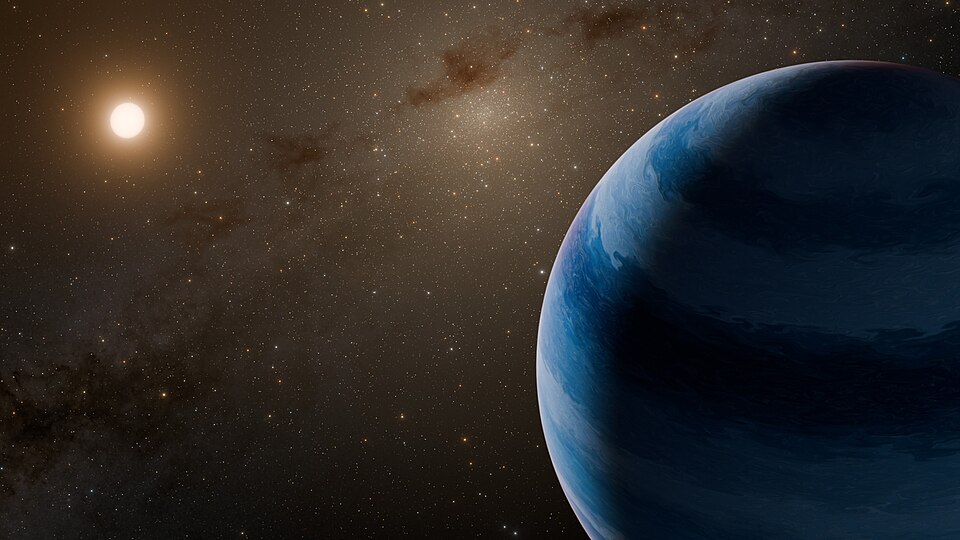
Exoplanets come in many different sizes and types. Hot Jupiters are giant gas planets that orbit very close to their stars, making them incredibly hot. Super-Earths are rocky planets larger than Earth but smaller than Neptune, and they are the most common type found so far. Some exoplanets are called ice giants because they are made mostly of water, ammonia, and methane ices. There are even rogue planets that wander through space without orbiting any star at all.
The Goldilocks Zone
Scientists are especially interested in exoplanets that orbit in the habitable zone, sometimes called the Goldilocks Zone. This is the region around a star where temperatures are just right for liquid water to exist on a planet’s surface. Water is essential for life as we know it, so planets in this zone are the best places to look for living things. Earth sits perfectly in our Sun’s habitable zone, which is why we have oceans and rivers. Several exoplanets have been found in habitable zones, including some in the TRAPPIST-1 system.
The TRAPPIST-1 System
One of the most exciting exoplanet discoveries is the TRAPPIST-1 system, announced in 2017. This system has seven Earth-sized rocky planets orbiting a small, cool star about 40 light-years from Earth. Three of these planets sit in the habitable zone where liquid water could exist. The star TRAPPIST-1 is much smaller and cooler than our Sun, so its planets orbit very close together. Scientists are using the James Webb Space Telescope to study the atmospheres of these planets and look for signs of water or other molecules.
What the James Webb Space Telescope Can Tell Us
The James Webb Space Telescope, launched in 2021, is a powerful tool for studying exoplanet atmospheres. When an exoplanet passes in front of its star, starlight filters through the planet’s atmosphere. By analyzing that filtered light, scientists can figure out what gases are in the atmosphere. They look for gases like water vapor, carbon dioxide, and methane, which could be signs of a world friendly to life. Webb has already begun studying exoplanets and has detected carbon dioxide in the atmosphere of a gas giant called WASP-39b.
Could There Be Life on Exoplanets?
One of the biggest questions in science is whether life exists beyond Earth. Finding an exoplanet with the right temperature, water, and atmosphere would be a major clue. Scientists look for biosignatures, which are chemicals in a planet’s atmosphere that could be produced by living things. On Earth, oxygen and methane together are biosignatures because living organisms produce both of these gases. We have not found proof of alien life yet, but with so many exoplanets to explore, many scientists believe it is only a matter of time.
The Future of Exoplanet Exploration
Scientists are planning even more powerful telescopes and missions to study exoplanets. Future telescopes may be able to take actual pictures of Earth-like exoplanets orbiting nearby stars. NASA and other space agencies are working on technology that could block out a star’s light to reveal the faint glow of its planets. The search for exoplanets has only been going on for about 30 years, and already we have found thousands of new worlds. As technology improves, we will learn more about these distant planets and whether any of them could be a second home for life.
 OtterKnow Kids Encyclopedia