What Shape Is Our Galaxy?
The Milky Way is a barred spiral galaxy, which means it has long arms that curve outward from a central bar-shaped core. If you could look at it from above, it would look like a giant pinwheel with several spiral arms. From the side, it would look like a thin disk with a bulge in the middle, kind of like two fried eggs stuck together. The disk of the Milky Way stretches about 100,000 light-years across, which means light itself takes 100,000 years to travel from one side to the other. Our solar system sits on one of the spiral arms, about 26,000 light-years from the center.
Our Place in the Galaxy
Earth and our solar system are located on the Orion Arm, which is one of the smaller spiral arms of the Milky Way. Our Sun orbits around the center of the galaxy, but it moves so slowly compared to the huge distances that one full orbit takes about 225 to 250 million years. Scientists sometimes call this long trip a “galactic year.” The last time Earth was in the same spot in the galaxy, dinosaurs had not yet appeared on our planet. Even though we are moving through space at about 515,000 miles per hour, the galaxy is so enormous that we barely notice the motion.
The Center of the Milky Way
At the very center of the Milky Way, there is a supermassive black hole called Sagittarius A* (pronounced “Sagittarius A-star”). This black hole has a mass about 4 million times greater than our Sun. Even though it is incredibly massive, it is too far away to affect Earth or our solar system. The center of the galaxy is hidden from our view by thick clouds of dust and gas, so scientists use special telescopes that detect radio waves and X-rays to study it. In 2022, astronomers captured the first-ever image of Sagittarius A* using the Event Horizon Telescope.
The Milky Way in the Night Sky
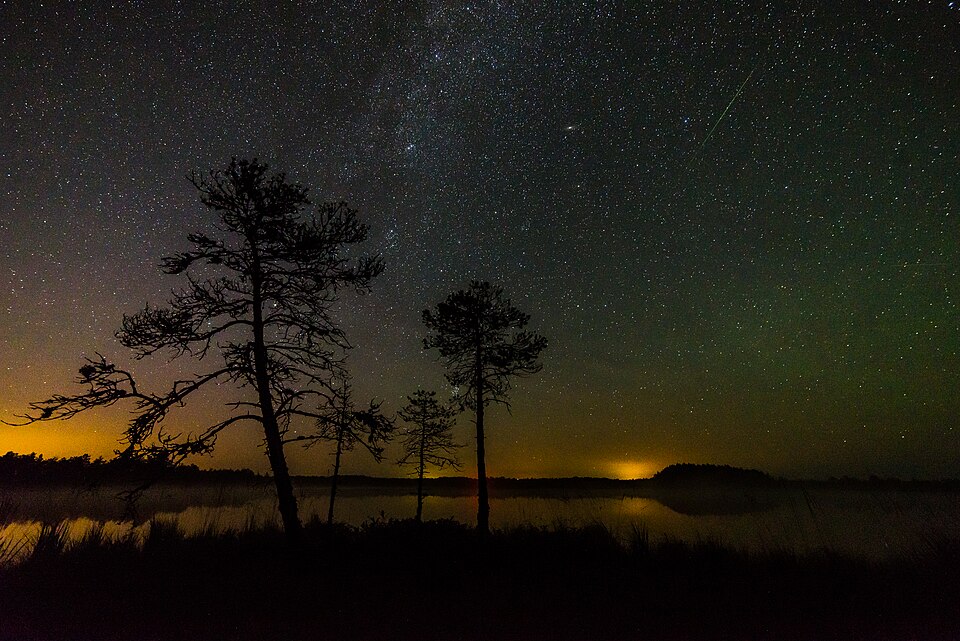
On a clear, dark night far from city lights, you can see the Milky Way as a glowing band of light stretching across the sky. This band is actually the combined light of billions of distant stars in the disk of our galaxy. Ancient cultures around the world created stories and myths to explain this mysterious streak of light. The best time to see the Milky Way in the Northern Hemisphere is during summer, when the brightest part of the galaxy is overhead. Light pollution from cities makes it very difficult to see, so national parks and rural areas are the best places to observe it.
Stars and Nebulae
The Milky Way is filled with different types of stars, from tiny red dwarfs to enormous blue supergiants. It also contains nebulae, which are giant clouds of gas and dust where new stars are born. The Orion Nebula is one of the most famous nebulae in our galaxy and can even be seen with the naked eye as a fuzzy patch in the constellation Orion. When massive stars die, they can explode as supernovae and create beautiful remnants that spread heavy elements throughout the galaxy. These elements eventually form new stars, planets, and even the building blocks of life.
Neighbors in Space
The Milky Way is not alone in space. It is part of a group of more than 50 galaxies called the Local Group. The closest large galaxy to ours is the Andromeda Galaxy, which is about 2.5 million light-years away. The Milky Way also has smaller companion galaxies called the Large and Small Magellanic Clouds, which can be seen from the Southern Hemisphere. In about 4 to 5 billion years, the Milky Way and the Andromeda Galaxy will collide and merge into one even larger galaxy.
Exploring Our Galaxy
Scientists use many different tools to study the Milky Way. Space telescopes like the Hubble Space Telescope and the James Webb Space Telescope help astronomers see distant stars and nebulae in sharp detail. The European Space Agency’s Gaia spacecraft has been mapping the positions and movements of nearly 2 billion stars in our galaxy since 2013. Radio telescopes can peer through the dust clouds that block visible light to reveal hidden structures in the galaxy. Every new discovery helps us understand our cosmic home a little bit better.
 OtterKnow Kids Encyclopedia