The Apollo Missions
Six Apollo missions successfully landed astronauts on the Moon: Apollo 11, 12, 14, 15, 16, and 17. Apollo 13 was supposed to land on the Moon, but an oxygen tank exploded during the trip, forcing the crew to return to Earth without landing. Each mission explored a different area of the Moon’s surface to help scientists learn as much as possible. The missions grew longer and more ambitious over time, with later crews spending up to three days on the lunar surface.
The First Moonwalkers
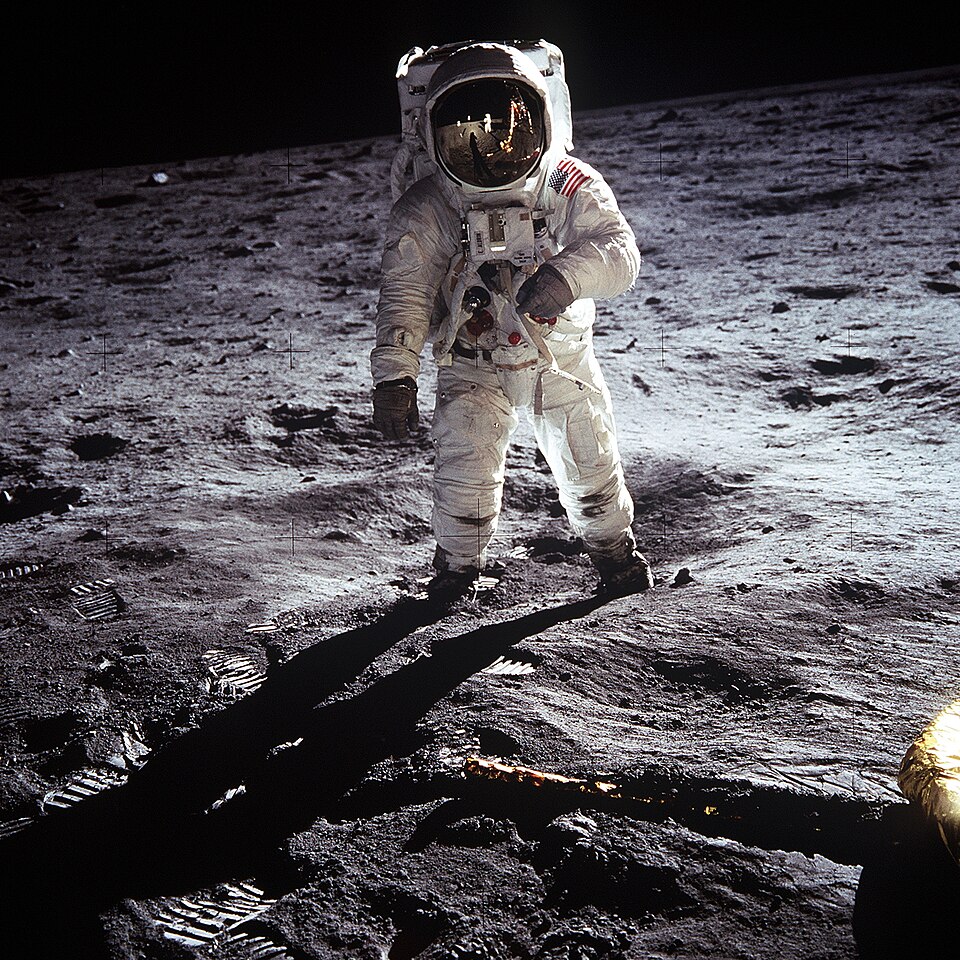
Neil Armstrong and Buzz Aldrin were the first two people to walk on the Moon on July 20, 1969, during the Apollo 11 mission. Armstrong famously said, “That’s one small step for man, one giant leap for mankind” as he stepped onto the surface. Aldrin joined him about 20 minutes later, and together they spent about two and a half hours outside their lunar module. Michael Collins orbited the Moon in the command module above, making him one of the most important but often forgotten members of the crew.
What Moonwalkers Did on the Surface
The astronauts had important scientific work to do during their time on the Moon. They collected a total of 842 pounds of Moon rocks and soil samples to bring back to Earth for study. They set up experiments that measured moonquakes, the Moon’s magnetic field, and particles from the Sun. On later missions, astronauts used a battery-powered rover called the Lunar Roving Vehicle to travel farther from their landing site and explore more of the surface.
The Challenges of Moonwalking
Walking on the Moon was very different from walking on Earth because the Moon’s gravity is only about one-sixth as strong. Astronauts had to learn a bouncing, hopping stride to move around without falling over. Their spacesuits weighed about 180 pounds on Earth but felt much lighter on the Moon, though the suits were still stiff and hard to bend in. Dust was a constant problem because the fine, sharp lunar dust stuck to everything and could damage equipment.
The Last Moonwalkers
Eugene Cernan and Harrison Schmitt were the last two people to walk on the Moon during the Apollo 17 mission in December 1972. Schmitt was the only scientist, a geologist, to walk on the Moon, while all the other moonwalkers were military test pilots. Cernan drove the lunar rover a record distance of about 22 miles during the mission. Before climbing back into the lunar module for the last time, Cernan said he hoped humans would return to the Moon someday soon.
All Twelve Moonwalkers
The complete list of people who walked on the Moon includes Neil Armstrong, Buzz Aldrin, Pete Conrad, Alan Bean, Alan Shepard, Edgar Mitchell, David Scott, James Irwin, John Young, Charles Duke, Eugene Cernan, and Harrison Schmitt. Alan Shepard was also the first American in space, making his moonwalk on Apollo 14 at age 47, the oldest person to walk on the Moon. John Young walked on the Moon during Apollo 16 and later commanded the first Space Shuttle mission. As of the mid-2020s, only a few of the twelve moonwalkers are still alive.
The Legacy of the Moonwalkers
The Apollo moonwalkers inspired millions of people around the world to dream about space exploration. The Moon rocks they brought back taught scientists that the Moon was likely formed when a Mars-sized object crashed into Earth billions of years ago. NASA’s Artemis program aims to return astronauts to the Moon, and this time the crew will include the first woman and first person of color to walk on the lunar surface. The courage and achievements of the original twelve moonwalkers paved the way for a new generation of space explorers.
 OtterKnow Kids Encyclopedia