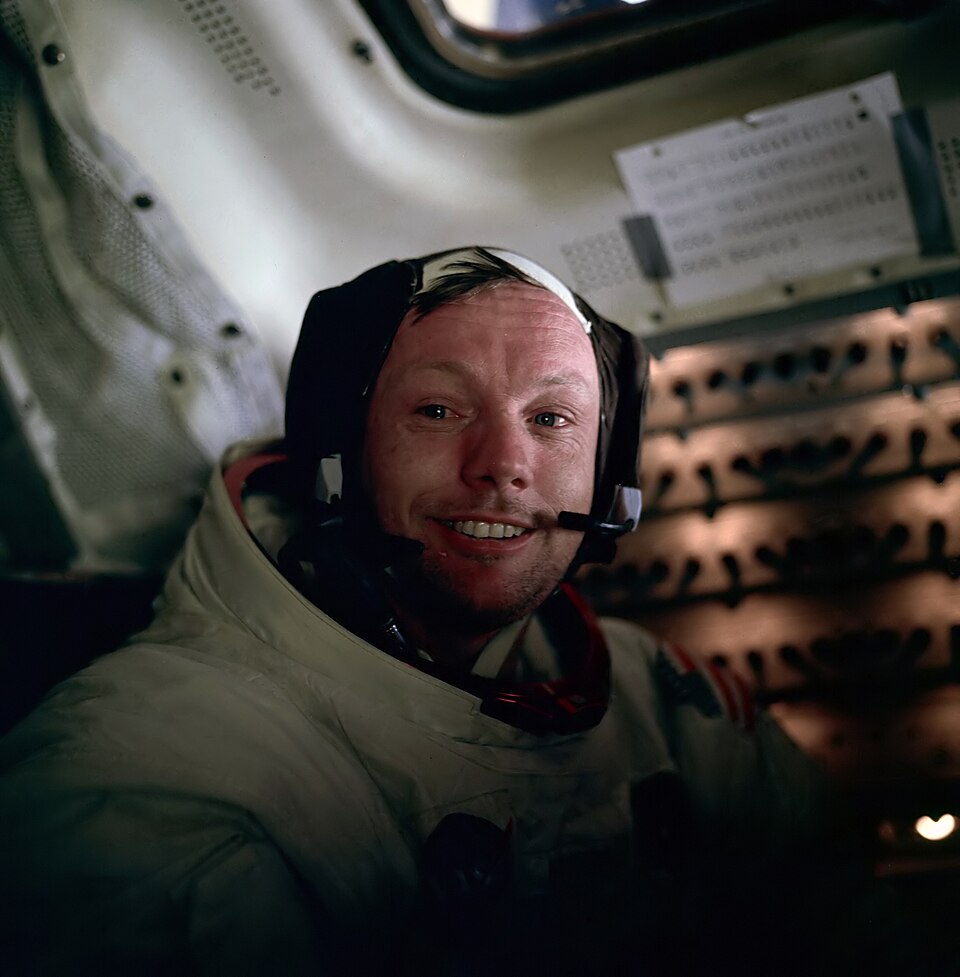
Early Life and Love of Flying
Neil Armstrong was born on August 5, 1930, in Wapakoneta, Ohio. He fell in love with airplanes at a young age after his father took him to an air show when he was just two years old. Armstrong earned his student pilot’s license at age 16, before he even had a driver’s license. He went on to study aeronautical engineering at Purdue University, where he learned about how aircraft are designed and built.
Military Service and Test Pilot Career
Armstrong served as a Navy fighter pilot during the Korean War, flying 78 combat missions. After the war, he became a test pilot at Edwards Air Force Base in California, where he flew some of the fastest and most experimental aircraft ever built. He piloted the X-15 rocket plane, reaching speeds of over 3,989 miles per hour and altitudes at the edge of space. His calm and skilled handling of dangerous situations earned him a reputation as one of the best pilots in the country.
Becoming an Astronaut
In 1962, Armstrong was selected as part of NASA’s second group of astronauts, sometimes called the “New Nine.” His first spaceflight was Gemini 8 in March 1966, where he performed the first successful docking of two spacecraft in orbit. During that mission, a thruster malfunction caused the spacecraft to spin dangerously, but Armstrong’s quick thinking saved the crew. His cool response under pressure helped NASA choose him to command the historic Apollo 11 mission.
The Apollo 11 Mission
On July 16, 1969, Armstrong, Buzz Aldrin, and Michael Collins launched from Kennedy Space Center in Florida aboard a Saturn V rocket. Four days later, Armstrong and Aldrin descended to the Moon’s surface in the lunar module called Eagle while Collins orbited above. Armstrong had to take manual control of the landing when he noticed the computer was guiding them toward a field of boulders, and he landed with only about 25 seconds of fuel remaining. He spent about two and a half hours walking on the Moon, collecting samples and taking photographs.
Life After the Moon
After returning to Earth as a worldwide hero, Armstrong was surprisingly private and avoided the spotlight. He left NASA in 1971 and became a professor of aerospace engineering at the University of Cincinnati, where he taught for eight years. Unlike many famous astronauts, he rarely gave interviews or signed autographs, preferring a quiet life on his farm in Ohio. He believed the Apollo 11 mission belonged to everyone who worked on it, not just to him.
Awards and Honors
Armstrong received some of the highest honors a person can earn, including the Presidential Medal of Freedom, the Congressional Gold Medal, and the Congressional Space Medal of Honor. He was inducted into the Astronaut Hall of Fame in 1993. The crater where Apollo 11 landed was informally named “Tranquility Base” in honor of the mission. NASA’s Armstrong Flight Research Center in California was renamed after him to honor his contributions to aviation and space exploration.
Remembering Neil Armstrong
Neil Armstrong passed away on August 25, 2012, at the age of 82 in Cincinnati, Ohio. His family released a statement asking people to honor him by giving a wink to the Moon the next time they looked up at it. Armstrong is remembered not only for being the first person on the Moon but also for his humility, courage, and dedication to exploration. His story shows that quiet determination and years of hard work can lead to achievements that change the world.
 OtterKnow Kids Encyclopedia