Earth’s Rotation
Earth spins like a giant top on an imaginary line called its axis, which runs from the North Pole to the South Pole. This rotation is what gives us day and night, as different parts of Earth face toward or away from the Sun. The same spinning motion also makes the stars appear to move across the night sky. Earth rotates from west to east, so stars appear to move in the opposite direction, from east to west. It takes exactly 23 hours and 56 minutes for Earth to complete one full rotation relative to the stars, which astronomers call a sidereal day.
Star Trails
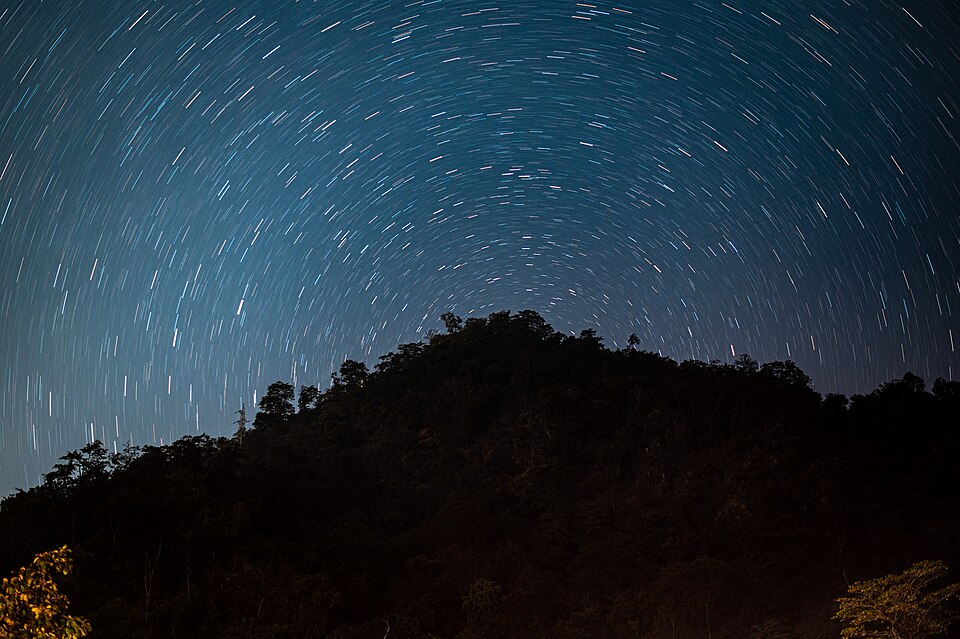
If you set up a camera and take a very long photograph of the night sky, the stars will appear as curved streaks of light called star trails. These trails show the apparent paths that stars follow as Earth rotates during the exposure. The trails form arcs, or partial circles, because the stars seem to rotate around a central point in the sky. Near the poles, the trails form tight circles, while near the horizon they appear as longer, flatter arcs. Star trail photographs are a beautiful way to see evidence of Earth’s rotation with your own eyes.
The North Star Stays Still
While most stars appear to move across the sky, one special star barely moves at all. Polaris, also known as the North Star, sits almost directly above Earth’s North Pole, very close to the point around which all other stars seem to rotate. Because of its position, Polaris appears to stay in nearly the same spot all night long while the other stars circle around it. For centuries, travelers and sailors have used Polaris to find their way because it always marks the direction of north. Polaris is located at the end of the handle of the Little Dipper constellation, also known as Ursa Minor.
Seasonal Changes in the Sky
The constellations you see in the sky change throughout the year because Earth orbits the Sun. As Earth moves along its orbit, we face different directions in space at different times of year, revealing different groups of stars. For example, the constellation Orion is visible in winter in the Northern Hemisphere but disappears from view during summer. It takes Earth about 365.25 days to complete one trip around the Sun, which is why we see the same constellations return to the same positions each year. Ancient farmers and navigators used these seasonal star patterns to track the passage of time and plan their activities.
How Location Affects What You See
The stars you can see depend on where you are on Earth. People living near the equator can see stars from both the northern and southern parts of the sky throughout the year. However, someone living in Canada would never see certain southern constellations like the Southern Cross, and someone in Australia would never see the Big Dipper high in the sky. The angle at which stars appear to move also changes with your latitude, with stars near the equator rising straight up and setting straight down. Your position on Earth determines which stars circle overhead and which remain hidden below the horizon.
Circumpolar Stars
Some stars never set below the horizon and can be seen every clear night of the year from your location. These are called circumpolar stars, and they appear to trace complete circles around the celestial pole. In the Northern Hemisphere, constellations like Ursa Major (the Big Dipper) and Cassiopeia are circumpolar for many observers. The closer you are to one of Earth’s poles, the more circumpolar stars you can see. At the North Pole itself, every visible star is circumpolar, and they all travel in circles parallel to the horizon without ever rising or setting.
Observing the Night Sky
You do not need a telescope to observe the apparent motion of stars. Simply go outside on a clear night, find a bright star, and note its position compared to a nearby tree or rooftop. If you check again an hour or two later, you will see that the star has moved noticeably to the west. You can also watch for the Big Dipper, which slowly rotates around Polaris like the hand of a giant clock. Keeping a sky journal where you sketch star positions at different times and dates is a great way to track these patterns yourself. Understanding why stars appear to move helps you appreciate how our spinning, orbiting planet connects us to the wider universe.
 OtterKnow Kids Encyclopedia