Structure and Spiral Arms
The Milky Way is a barred spiral galaxy, which means it has a bar-shaped core of stars at its center with several long, curving arms spiraling outward. The major arms include the Perseus Arm, the Sagittarius Arm, the Scutum-Centaurus Arm, and the Orion Arm, where our solar system is located. The galaxy’s disk is about 100,000 light-years across but only about 2,000 light-years thick, making it shaped something like a very thin pancake with a bulge in the middle. That central bulge is packed with older stars and contains a supermassive black hole called Sagittarius A*, which has a mass equal to about 4 million of our Suns.
Size and Scale
The Milky Way is enormous, but it can be hard to picture just how big it really is. Light, which travels at about 186,000 miles per second, takes 100,000 years to cross from one edge of the galaxy to the other. Our solar system orbits the galactic center at roughly 515,000 miles per hour, but even at that incredible speed, it takes about 230 million years to complete a single orbit. Scientists call this period a “galactic year.” Since the Sun formed about 4.6 billion years ago, it has orbited the center of the Milky Way only about 20 times. The galaxy contains an estimated 100 billion to 400 billion stars, and astronomers believe there may be at least as many planets.
Our Place in the Galaxy
Our solar system sits in the Orion Arm, a smaller arm located between two major spiral arms. We are roughly 26,000 light-years from the galactic center, placing us a little more than halfway out from the middle toward the edge. Because we live inside the galaxy’s disk, we cannot see its spiral shape directly. Instead, when we look toward the center of the galaxy, which is in the direction of the constellation Sagittarius, we see the thickest and brightest part of the Milky Way band. When we look outward toward the edge, we see fewer stars and the sky appears darker.
History of Discovery
For most of human history, people did not understand what the Milky Way really was. The ancient Greek philosopher Democritus, around 400 BCE, was one of the first to suggest that the glowing band might be made of distant stars. In 1610, the Italian astronomer Galileo Galilei pointed his telescope at the Milky Way and confirmed that it was indeed made up of countless individual stars too faint to see with the naked eye. In the 1780s, William Herschel tried to map the galaxy’s shape by counting stars in different directions. It was not until the 1920s that astronomer Edwin Hubble proved that some “nebulae” were actually separate galaxies far beyond the Milky Way, showing that our galaxy was just one of many in the universe.
Other Galaxies and the Local Group
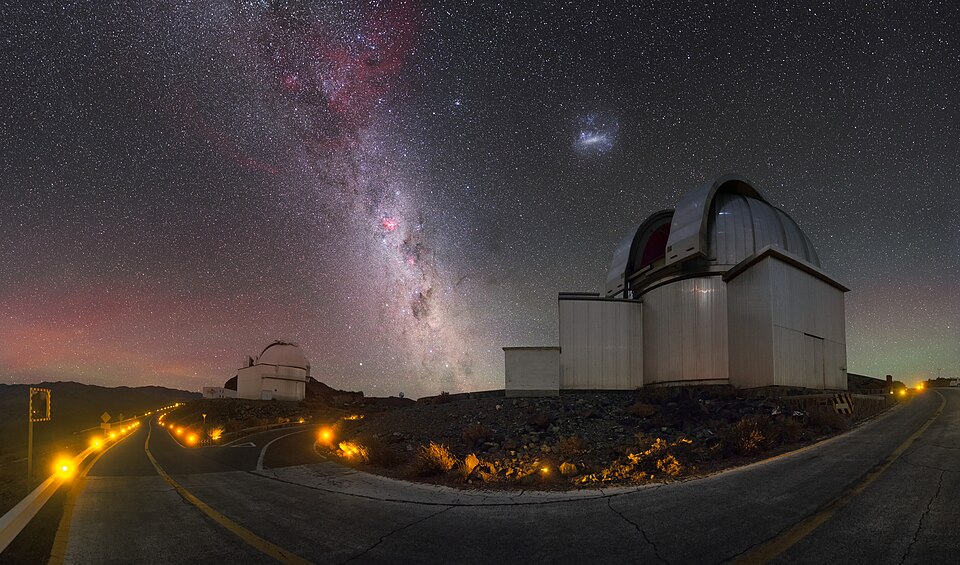
The Milky Way is not alone in space. It belongs to a cluster of more than 80 galaxies called the Local Group. The largest member is the Andromeda Galaxy, a spiral galaxy about 2.5 million light-years away that you can actually spot with your naked eye on a dark night as a faint, fuzzy patch in the constellation Andromeda. The Milky Way and Andromeda are moving toward each other and are expected to collide and merge in about 4.5 billion years, eventually forming a single, larger galaxy. Two smaller galaxies called the Large and Small Magellanic Clouds orbit the Milky Way as satellite galaxies and are visible from the Southern Hemisphere.
Observing the Milky Way
You do not need a telescope to enjoy the Milky Way. The best viewing conditions are on a moonless night, far from the glow of city lights, during summer or early fall when the galactic center is high in the sky for Northern Hemisphere observers. From a truly dark location, the Milky Way appears as a broad, glowing river of light filled with brighter patches and dark lanes where dust clouds block the starlight behind them. Binoculars reveal that the smooth glow breaks apart into thousands of individual stars, star clusters, and nebulae. Light pollution from cities is one of the biggest obstacles to seeing the Milky Way today, which is why dark sky preserves and national parks are some of the best places to experience this spectacular view.
 OtterKnow Kids Encyclopedia