What Kind of Star Is Polaris?
Polaris is a yellow supergiant star, much larger and brighter than our Sun. It is about 44 times wider than the Sun and shines with the light of nearly 2,500 Suns. Polaris is roughly 400 light-years away from Earth. Even though it looks like a single point of light, Polaris is actually a system of three stars. The main star, Polaris A, is the giant, and it has two smaller companion stars orbiting it. Polaris A is also a special type of star called a Cepheid variable, which means it pulses slightly in brightness over a regular cycle of about four days.
Ursa Minor and Finding Polaris
Polaris is the brightest star in the constellation Ursa Minor, or the Little Bear. The easiest way to find Polaris is by using the Big Dipper, which is part of the nearby constellation Ursa Major. The two stars at the outer edge of the Big Dipper’s bowl are called the “pointer stars.” If you draw an imaginary line through these two stars and extend it about five times the distance between them, you will arrive at Polaris. This trick works any time of year, as long as you are in the Northern Hemisphere and the sky is clear.
Navigation Through History
Long before GPS, compasses, or detailed maps existed, Polaris was one of the most reliable tools for navigation. Ancient Phoenician sailors used it to cross the Mediterranean Sea. Polynesian voyagers, Viking explorers, and traders along the Silk Road all looked to Polaris to guide their journeys. In American history, enslaved people escaping to freedom followed the North Star as a guide northward. Because Polaris always indicates the direction of true north, any traveler who could see it could figure out which way they were heading.
Precession: The North Star Won’t Always Be Polaris
Earth spins like a top, but it also wobbles very slowly. This wobble is called precession, and it takes about 26,000 years for Earth’s axis to trace a complete circle in space. Right now, Earth’s axis happens to point almost directly at Polaris, making it our North Star. But this has not always been the case. About 5,000 years ago, when the ancient Egyptians were building the Great Pyramids, the star Thuban in the constellation Draco was the North Star. In about 12,000 years, the bright star Vega in the constellation Lyra will take over as the North Star.
Cepheid Variable Stars
Polaris belongs to a class of stars called Cepheid variables, named after the star Delta Cephei. These stars expand and contract in a regular rhythm, causing their brightness to rise and fall in a predictable pattern. Astronomers discovered that there is a direct relationship between how long a Cepheid’s cycle takes and how bright the star truly is. This discovery was hugely important because it gave scientists a way to measure distances in space. By comparing how bright a Cepheid appears from Earth with how bright it actually is, astronomers can calculate how far away it is. Polaris has a pulsation period of about 3.97 days.
Fun Facts
- Polaris is the 50th brightest star in the night sky, so it is not especially bright compared to other stars. Its fame comes from its position, not its brilliance.
- If you stood exactly at the North Pole, Polaris would appear directly overhead.
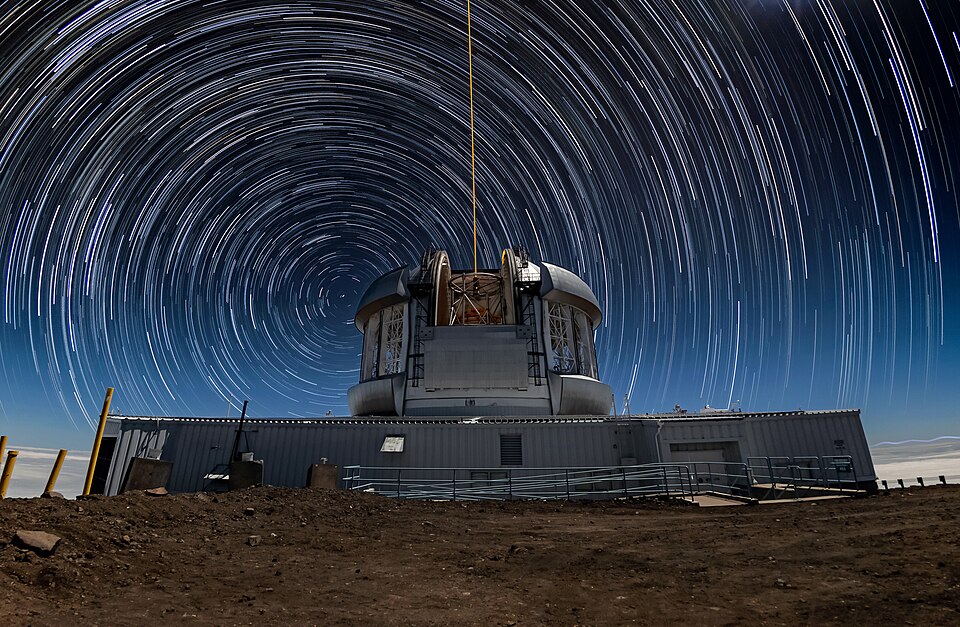
- Star trail photographs, made by leaving a camera shutter open for hours, show all stars drawing circles around Polaris.
- The Southern Hemisphere does not have a bright pole star. The spot above the South Pole has only faint stars near it.
- Polaris has been getting slightly brighter over the past century, and scientists are still studying why.
 OtterKnow Kids Encyclopedia