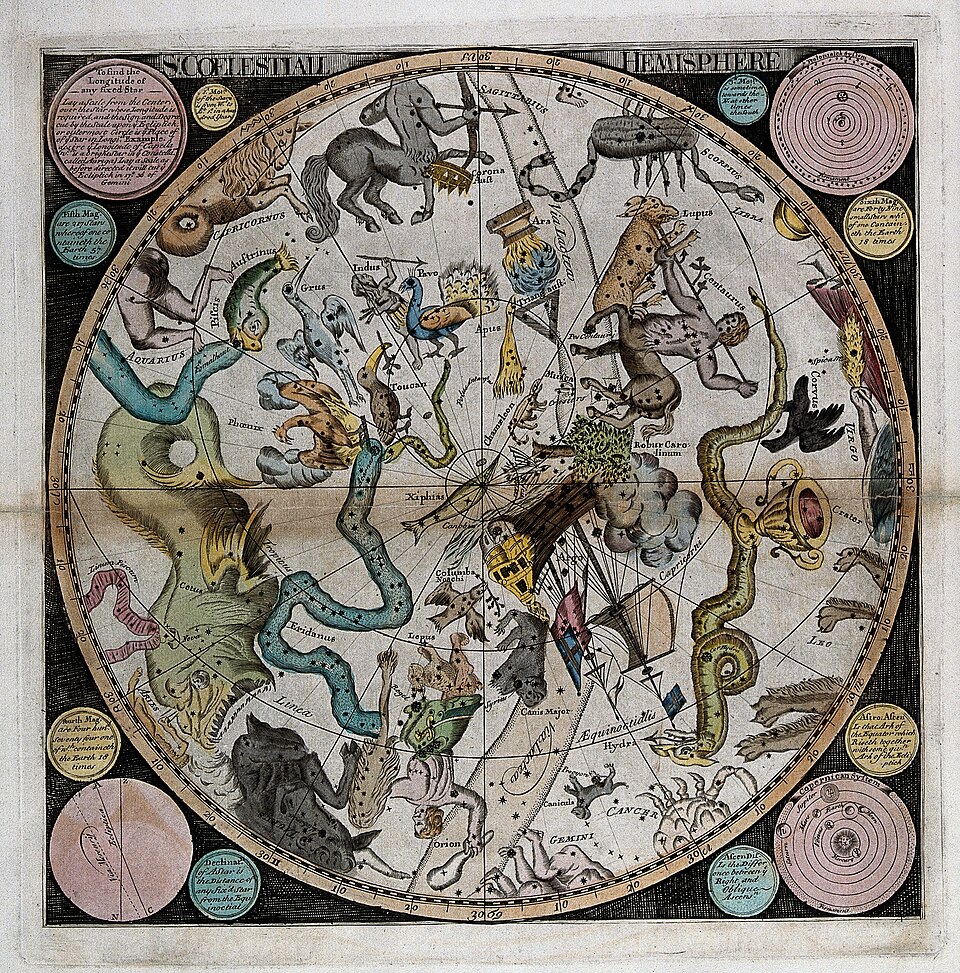
How Star Charts Work
Star charts show the sky as if you were looking straight up from the ground. The edge of a circular star chart represents your horizon, and the center represents the point directly above your head, called the zenith. Stars and constellations are drawn as dots and lines on the chart, with brighter stars shown as larger dots. Because the Earth rotates, different stars are visible at different times of night and different seasons. That is why most star charts are designed for a specific date and time.
What Is a Planisphere?
A planisphere is a special type of star chart with two rotating discs stacked on top of each other. The bottom disc shows all the stars visible from your latitude throughout the year. The top disc has an oval window that reveals only the stars you can see at a particular date and time. You turn the top disc to line up the current date with the current time, and the window shows your night sky. Planispheres are reusable year after year, making them a favorite tool for beginner stargazers.
Reading a Star Chart
To read a star chart, start by facing a known direction like north or south. Hold the chart so that the direction you are facing is at the bottom of the chart. The stars near the bottom edge of the chart will be the ones closest to the horizon in front of you. Look for the brightest stars and most recognizable patterns first, such as the Big Dipper or Orion. Once you find one constellation, you can use it as a landmark to hop to nearby constellations on the chart.
Why the Sky Changes
The night sky looks different depending on the time of year because Earth orbits the Sun. As our planet moves along its orbit, we face different directions in space, revealing different constellations each season. For example, Orion is a winter constellation in the Northern Hemisphere, while Scorpius dominates summer skies. The sky also shifts throughout the night because Earth rotates on its axis, making stars appear to rise in the east and set in the west. This is why star charts need both a date and a time to be accurate.
Star Magnitude and Brightness
Star charts use a system called magnitude to show how bright each star appears. The lower the magnitude number, the brighter the star, which can seem backward at first. A star with a magnitude of 1 is very bright, while a star with a magnitude of 6 is barely visible to the naked eye. The brightest star in the night sky, Sirius, has a magnitude of about negative 1.46. Star charts usually show brighter stars as bigger dots so they are easier to spot on the map.
Tips for Stargazing with a Chart
The best stargazing happens away from city lights, where the sky is darker and more stars are visible. Give your eyes at least 15 to 20 minutes to adjust to the darkness before using your chart. Use a red flashlight or cover a regular flashlight with red cellophane to read your chart without ruining your night vision. Red light does not cause your pupils to shrink the way white light does. Dress warmly, bring a blanket to lie on, and be patient as you match what you see above with the patterns on your chart.
Digital Star Charts and Apps
Today, many stargazers use digital star chart apps on smartphones and tablets. These apps use your phone’s GPS and sensors to show you exactly which stars and constellations are above you in real time. You can point your phone at the sky, and the app labels what you are looking at. Popular apps include Stellarium, Sky Map, and Star Walk. While digital tools are very convenient, learning to use a paper star chart first helps you understand how the sky works and builds skills you can use anywhere.
 OtterKnow Kids Encyclopedia