Meteoroids, Meteors, and Meteorites
Scientists use three different words depending on where the space rock is. A meteoroid is the rock while it is still traveling through space, and they can range in size from specks of dust to objects about one meter across. Once a meteoroid enters Earth’s atmosphere and starts to glow, it becomes a meteor. If any piece of the rock survives its fiery trip through the atmosphere and lands on Earth’s surface, it is called a meteorite. Most meteoroids are so small that they burn up completely, and only the larger ones leave meteorites behind. The largest meteorite ever found is the Hoba meteorite in Namibia, which weighs about 60 metric tons.
What Causes Meteor Showers?
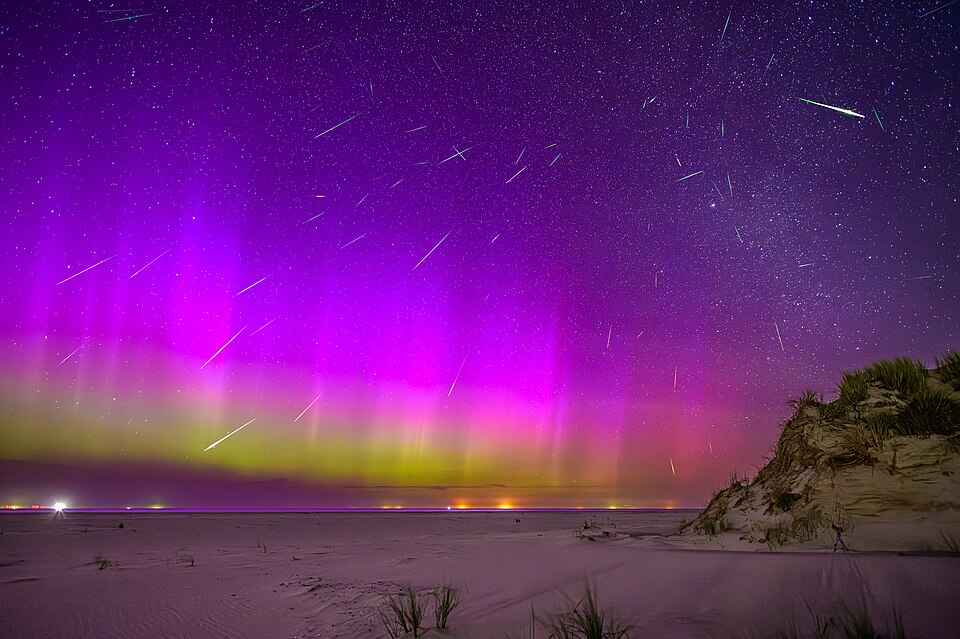
Meteor showers happen when Earth passes through a trail of debris left behind by a comet. As comets orbit the Sun, the Sun’s heat causes them to shed dust, ice, and small rocks along their path. Earth crosses these debris trails at the same point in its orbit every year, which is why meteor showers happen on a predictable schedule. When many meteoroids enter the atmosphere around the same time, you can see dozens or even hundreds of meteors in a single night. The meteors in a shower all appear to come from the same point in the sky, called the radiant.
Famous Meteor Showers
The Perseids are one of the most popular meteor showers, peaking every year around August 11-13 with up to 100 meteors per hour. They are caused by debris from Comet Swift-Tuttle, which orbits the Sun every 133 years. The Geminids in December are actually the strongest annual meteor shower, producing up to 150 meteors per hour, and they come from an unusual object called 3200 Phaethon that may be a dead comet. The Leonids, which peak in November, occasionally produce meteor storms with thousands of meteors per hour, though this is rare. Other well-known showers include the Lyrids in April, the Eta Aquariids in May, and the Orionids in October.
How to Watch a Meteor Shower
You do not need a telescope or binoculars to watch a meteor shower — just your eyes and a dark sky. The best viewing happens after midnight, when your side of Earth is facing into the stream of debris. Find a spot away from city lights, lie on your back, and give your eyes about 20 to 30 minutes to adjust to the darkness. Look at a wide area of the sky rather than staring at one spot, since meteors can appear anywhere. Be patient and dress warmly, because the best meteor showers often happen during cold months.
Famous Meteorite Impacts
About 66 million years ago, a massive asteroid or meteorite about 10 kilometers wide struck what is now Mexico’s Yucatan Peninsula, creating the Chicxulub crater. This impact is believed to have caused the mass extinction that wiped out the dinosaurs and about 75 percent of all species on Earth. Meteor Crater in Arizona, about 1.2 kilometers wide, was created around 50,000 years ago by a meteorite roughly 50 meters across. In 1908, an object exploded over Tunguska, Siberia, flattening about 2,000 square kilometers of forest even though no crater was found. In 2013, a small asteroid exploded over Chelyabinsk, Russia, creating a shockwave that shattered windows and injured about 1,500 people.
Studying Meteorites
Scientists study meteorites because they are some of the oldest materials in our solar system, dating back about 4.6 billion years. By examining meteorites, researchers can learn what the early solar system was like before planets fully formed. Some meteorites contain amino acids, which are the building blocks of life, raising exciting questions about how life may have started on Earth. There are three main types of meteorites: stony (the most common), iron, and stony-iron. Space agencies like NASA track near-Earth objects to watch for any large asteroids that could potentially threaten our planet in the future.
Meteors on Other Planets
Earth is not the only place where meteors occur — any world with an atmosphere can have them. Mars has a thin atmosphere, and NASA’s rovers and orbiters have spotted meteors streaking through the Martian sky. Jupiter’s thick atmosphere gets hit by space debris frequently, and in 1994, the comet Shoemaker-Levy 9 broke apart and crashed into Jupiter in a spectacular series of impacts. Scientists have also detected meteor activity in the atmospheres of Saturn and Venus. Studying meteors on other planets helps scientists understand the amount of space debris in different parts of the solar system.
 OtterKnow Kids Encyclopedia