Earth’s Tilted Axis
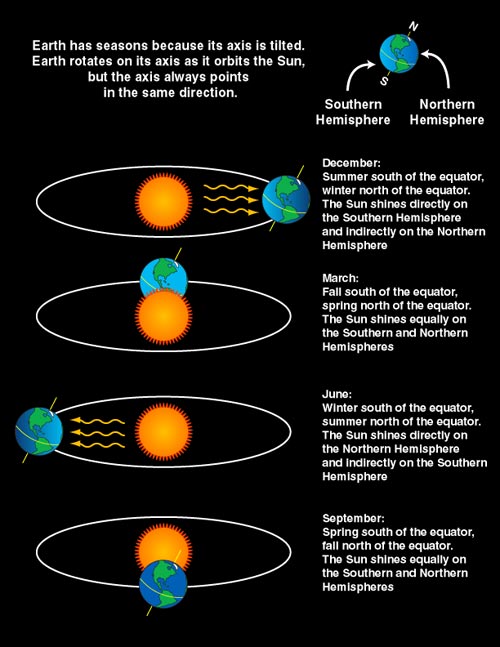
Earth spins like a top on its axis once every 24 hours, giving us day and night. But this axis is not perfectly straight up and down — it leans to one side at an angle of about 23.5 degrees. Scientists believe this tilt was caused by a giant collision between Earth and a Mars-sized object billions of years ago, the same event that likely created our Moon. The direction of Earth’s tilt stays nearly the same as the planet orbits the Sun, always pointing toward the North Star, Polaris. This means that for part of the year the North Pole leans toward the Sun, and for another part it leans away.
Summer and Winter
When the Northern Hemisphere is tilted toward the Sun, it experiences summer. During summer, the Sun appears higher in the sky and daylight lasts longer, sometimes more than 15 hours in northern areas. The Sun’s rays hit the ground at a steep angle, which concentrates the energy and makes temperatures warmer. Six months later, when the Northern Hemisphere is tilted away from the Sun, it experiences winter with shorter days and lower temperatures. At the same time, the Southern Hemisphere is tilted toward the Sun and enjoys summer, which is why December is warm in countries like Australia and Brazil.
Spring and Fall
Spring and fall are transition seasons that happen between summer and winter. During these seasons, neither hemisphere is tilted strongly toward or away from the Sun, so temperatures are moderate and days are medium length. In spring, the days gradually get longer and warmer as a hemisphere tilts more toward the Sun. In fall, the days get shorter and cooler as that hemisphere begins to tilt away from the Sun. Many plants and animals respond to these changes — trees grow new leaves in spring and drop them in fall, and some birds migrate to warmer places as winter approaches.
Solstices and Equinoxes
The year includes four special astronomical events that mark the beginning of each season. The summer solstice, around June 20-21, is the longest day of the year in the Northern Hemisphere and marks the start of summer. The winter solstice, around December 21-22, is the shortest day and marks the start of winter. The two equinoxes happen around March 20 and September 22, when day and night are nearly equal in length all over the world. The word “equinox” comes from Latin words meaning “equal night,” because daytime and nighttime are almost exactly the same length on those days.
Seasons Around the World
Not every place on Earth experiences four distinct seasons. Near the equator, the Sun is almost directly overhead all year long, so tropical regions stay warm with little temperature change between months. Instead of summer and winter, many tropical areas have wet and dry seasons caused by shifting wind patterns. Near the North and South Poles, seasons are extreme — the Arctic and Antarctic experience months of continuous daylight in summer and months of darkness in winter. In between, temperate regions like much of the United States, Europe, and parts of Asia experience the classic four-season cycle that most people are familiar with.
How Seasons Affect Life on Earth
Seasons have a powerful effect on plants, animals, and people around the world. Many trees in temperate regions are deciduous, meaning they lose their leaves in fall to save energy during the cold, dark winter months. Animals adapt to seasons in different ways — some hibernate through winter, some grow thicker fur, and some migrate hundreds or thousands of miles to find food and warmth. Farmers depend on the seasons to know when to plant and harvest their crops, since most food plants need specific amounts of sunlight and warmth to grow. Even human activities change with the seasons, from winter sports like skiing to summer activities like swimming.
A Common Misconception
One of the biggest misunderstandings about seasons is that they are caused by Earth’s distance from the Sun. In reality, Earth’s orbit is nearly circular, and the difference between its closest and farthest points from the Sun is only about 3 million miles (5 million kilometers), which is a small change compared to the average distance of 93 million miles (150 million kilometers). In fact, Earth is actually closest to the Sun in early January, during winter in the Northern Hemisphere. This proves that distance is not what causes seasons — it is all about the tilt and the angle at which sunlight strikes the surface. Understanding this helps us appreciate how a small tilt of just 23.5 degrees shapes life across our entire planet.
 OtterKnow Kids Encyclopedia