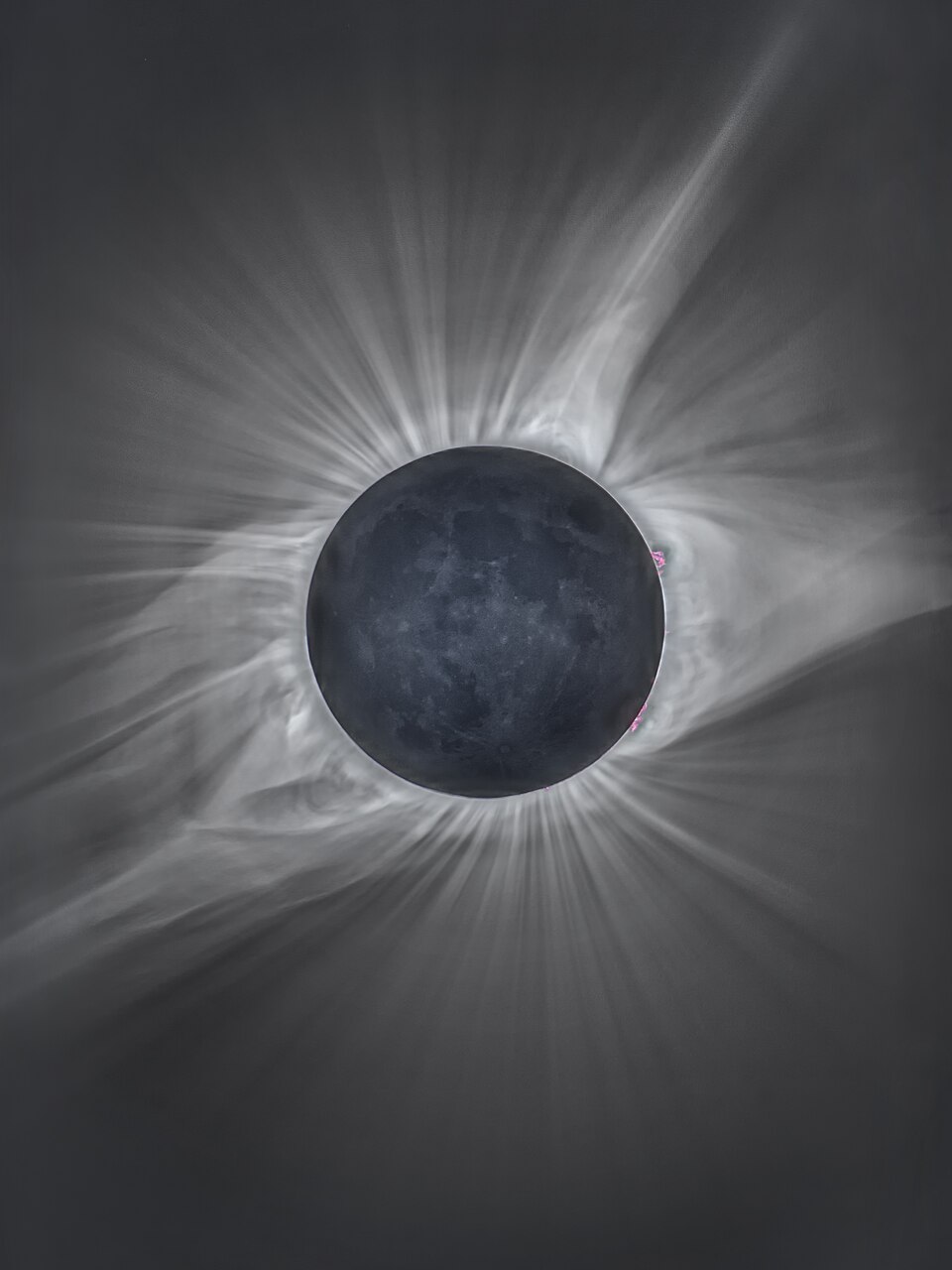
Why the Moon Can Block the Sun
The Sun is about 400 times wider than the Moon, but it is also roughly 400 times farther away from Earth. This lucky coincidence means the Sun and Moon appear to be almost exactly the same size in our sky. Because of this match in apparent size, the Moon can cover the Sun almost perfectly during a total eclipse. No other known planet in our solar system has a moon that matches its star so precisely. Scientists believe this is just a lucky accident of nature.
Types of Solar Eclipses
There are three main types of solar eclipses: total, partial, and annular. A total solar eclipse occurs when the Moon completely covers the Sun, turning day into an eerie twilight. A partial solar eclipse happens when only part of the Sun is blocked, so it looks like something took a bite out of it. An annular eclipse occurs when the Moon is slightly farther from Earth and appears a bit smaller than the Sun, leaving a bright ring of sunlight visible around the edges. Each type creates a different view in the sky.
The Path of Totality
During a total solar eclipse, the Moon’s darkest shadow, called the umbra, traces a narrow path across Earth’s surface. This path is called the path of totality, and it is usually only about 100 miles wide. People standing inside this path experience total darkness for a few minutes as the Moon completely covers the Sun. Outside the path, observers see a partial eclipse where only part of the Sun is blocked. The path of totality can stretch for thousands of miles across continents and oceans.
The Sun’s Corona
One of the most spectacular sights during a total solar eclipse is the Sun’s corona. The corona is the outermost layer of the Sun’s atmosphere, made of extremely hot gas that stretches millions of miles into space. Normally, the corona is invisible because the Sun’s bright surface outshines it completely. During totality, when the Moon blocks the Sun’s face, the corona appears as a glowing, pearly-white halo around the dark disk of the Moon. Scientists study the corona during eclipses to learn more about solar winds and how the Sun affects Earth.
How to Watch Safely
Looking directly at the Sun during a solar eclipse can seriously damage your eyes, even causing permanent blindness. You should never look at the Sun without special solar eclipse glasses that have certified filters to block harmful rays. Regular sunglasses, even very dark ones, do not provide enough protection. Another safe way to watch is by using a pinhole projector, which projects an image of the eclipsed Sun onto a piece of paper. During the brief moments of totality in a total eclipse, it is safe to look without glasses, but you must put them back on as soon as the Sun begins to reappear.
Famous Solar Eclipses in History
Solar eclipses have fascinated and sometimes frightened people throughout history. Ancient Chinese records describe a solar eclipse as far back as 2134 BCE, making it one of the earliest recorded astronomical events. In 1919, a total solar eclipse helped prove Albert Einstein’s theory of general relativity by showing that the Sun’s gravity bends starlight. The total solar eclipse of August 21, 2017, crossed the entire United States from coast to coast and was watched by millions of people. The next total solar eclipse visible from North America occurred on April 8, 2024, passing through Mexico, the United States, and Canada.
Predicting Solar Eclipses
Today, scientists can predict exactly when and where solar eclipses will happen, sometimes hundreds of years into the future. They use precise calculations of the orbits of the Earth and Moon to figure out when the three bodies will line up. The Saros cycle is a pattern that astronomers discovered long ago, showing that similar eclipses repeat roughly every 18 years and 11 days. Ancient civilizations like the Babylonians also noticed patterns in eclipses and used them to make predictions. Any given spot on Earth will experience a total solar eclipse about once every 375 years on average.
 OtterKnow Kids Encyclopedia