The Story of Pluto
Pluto was discovered in 1930 by a young American astronomer named Clyde Tombaugh. For 76 years, Pluto was considered the ninth planet in our solar system, and many people grew up learning about it in school. In 2006, the International Astronomical Union decided that Pluto did not meet all the requirements to be called a planet, so it was reclassified as a dwarf planet. This decision surprised many people, and some were even upset about it! Pluto is still a very interesting world, and in 2015, NASA’s New Horizons spacecraft flew past it and sent back the first close-up pictures.
Pluto Up Close
When New Horizons reached Pluto, scientists were amazed by what they saw. Pluto has a giant heart-shaped area on its surface called Tombaugh Regio, named after the man who discovered it. This bright, icy plain is made mostly of frozen nitrogen and is surprisingly smooth. Pluto also has tall mountains made of water ice that can reach up to 11,000 feet high, which is almost as tall as some mountains in the Rocky Mountains on Earth. The dwarf planet even has a thin atmosphere made mostly of nitrogen gas that expands and shrinks as Pluto moves closer to and farther from the Sun.
Eris and the Scattered Disc
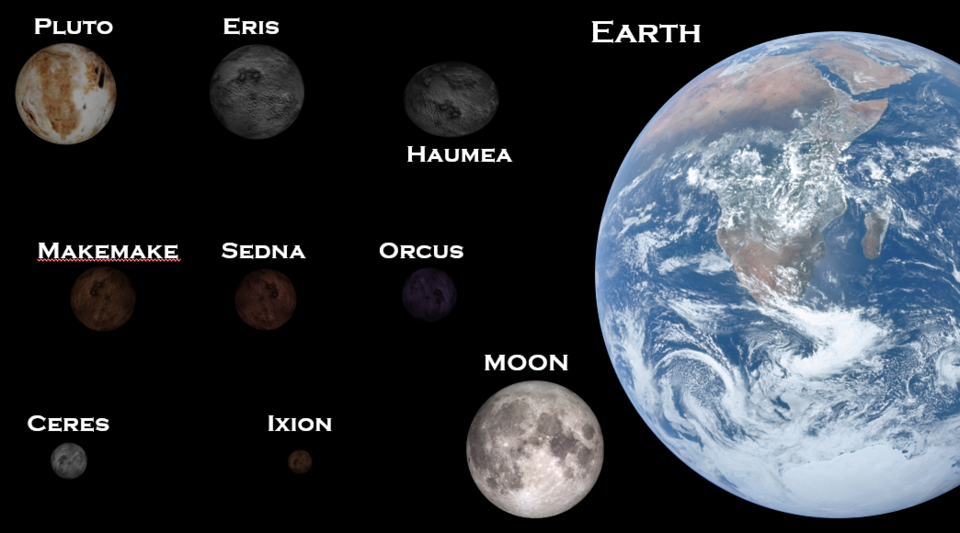
Eris is the most massive dwarf planet known in our solar system, and its discovery in 2005 is what started the whole debate about what counts as a planet. Eris is about the same size as Pluto but is 27 percent more massive. It orbits far beyond Pluto in a region called the scattered disc, taking about 558 years to complete one trip around the Sun. Eris has one known moon called Dysnomia, and together they travel through some of the coldest and most distant parts of our solar system.
Ceres: The Closest Dwarf Planet
Ceres is the only dwarf planet located in the inner solar system, sitting in the asteroid belt between Mars and Jupiter. It was actually discovered way back in 1801, long before any other dwarf planet, and was originally called a planet before being reclassified as an asteroid. Ceres is the smallest of the recognized dwarf planets, with a diameter of about 585 miles. NASA’s Dawn spacecraft orbited Ceres from 2015 to 2018 and found bright spots on its surface that turned out to be deposits of sodium carbonate, a type of salt. Scientists believe Ceres may have a layer of liquid water beneath its surface.
Haumea and Makemake
Haumea is one of the most unusual objects in the solar system because of its stretched-out, egg-like shape. It spins incredibly fast, completing one rotation in just about four hours, which is the fastest spin of any known large object in the solar system. Haumea even has two small moons and a faint ring of particles around it. Makemake, another dwarf planet in the outer solar system, was discovered in 2005 and is one of the brightest objects in the Kuiper Belt. Makemake has a reddish-brown surface covered in frozen methane and ethane.
Where Dwarf Planets Live
Most dwarf planets orbit in the Kuiper Belt, a huge ring of icy objects that lies beyond Neptune’s orbit. The Kuiper Belt stretches from about 30 to 50 times the distance from the Earth to the Sun. Eris orbits even farther out in the scattered disc, which extends much deeper into space. Ceres is the exception, orbiting much closer to the Sun in the asteroid belt. Scientists think there could be dozens or even hundreds of undiscovered dwarf planets in the outer regions of our solar system, waiting to be found.
Why Dwarf Planets Matter
Studying dwarf planets helps scientists understand how our solar system formed billions of years ago. These small, icy worlds are like time capsules that have preserved materials from the early solar system. By examining their surfaces and compositions, scientists can learn about the building blocks that came together to create the planets. Missions like New Horizons and Dawn have shown us that dwarf planets have mountains, ice plains, and possibly underground oceans. As technology improves, future missions may reveal even more surprises hidden on these distant worlds.
 OtterKnow Kids Encyclopedia