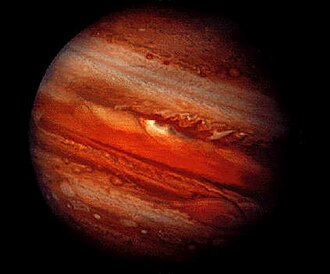
A Giant Ball of Gas
Unlike Earth, Jupiter does not have a solid surface you could stand on. It is classified as a gas giant, meaning it is made mostly of hydrogen and helium gases. Deep inside the planet, the pressure is so intense that hydrogen gets squeezed into a liquid metal. Scientists believe Jupiter may have a small rocky core at its very center, but no spacecraft has ever been able to see it. The planet’s atmosphere is thousands of miles thick, with colorful bands of clouds stretching across it.
The Great Red Spot
One of Jupiter’s most famous features is the Great Red Spot, a massive storm that has been raging for at least 350 years. This storm is so large that Earth could fit inside it. Winds inside the Great Red Spot can reach speeds of up to 400 miles per hour, which is much faster than any hurricane on Earth. The storm appears as a reddish oval shape in Jupiter’s southern hemisphere. Scientists are still studying why the storm has lasted so long and what gives it its reddish color.
Jupiter’s Many Moons
Jupiter has at least 95 known moons, more than any other planet in our solar system. The four largest moons are called the Galilean moons because they were discovered by the astronomer Galileo Galilei in 1610. These four moons are Io, Europa, Ganymede, and Callisto, and each one is a world worth exploring on its own. Ganymede is the largest moon in the entire solar system and is even bigger than the planet Mercury. Europa is covered in a thick layer of ice, and scientists think there may be a liquid ocean beneath the surface that could possibly support life.
Jupiter’s Rings and Magnetic Field
Many people do not realize that Jupiter has rings, just like Saturn. Jupiter’s rings are much thinner and fainter than Saturn’s, so they are very difficult to see. They are made mostly of tiny dust particles knocked off Jupiter’s small inner moons by meteorite impacts. Jupiter also has the strongest magnetic field of any planet in our solar system, about 20,000 times stronger than Earth’s. This powerful magnetic field creates intense radiation belts around the planet that can damage spacecraft.
Exploring Jupiter
Several spacecraft have visited Jupiter to study it up close. The Pioneer 10 and 11 missions flew past Jupiter in the 1970s, sending back the first close-up images. The Voyager 1 and 2 spacecraft followed in 1979, discovering Jupiter’s faint rings and active volcanoes on the moon Io. NASA’s Juno spacecraft arrived at Jupiter in 2016 and has been orbiting the planet to study its atmosphere, magnetic field, and interior. Juno has sent back detailed images and revealed new information about Jupiter’s polar storms and deep atmosphere.
How Jupiter Affects the Solar System
Jupiter’s massive size gives it a powerful gravitational pull that affects the rest of the solar system. Some scientists call Jupiter a “cosmic vacuum cleaner” because its gravity can pull in or redirect asteroids and comets that might otherwise head toward Earth. Jupiter’s gravity also helped shape the orbits of other planets when the solar system was forming billions of years ago. The planet’s strong gravitational influence is one reason why the asteroid belt exists between Mars and Jupiter. Without Jupiter, the inner solar system might have been bombarded by far more space debris over its history.
Fun Facts About Jupiter
Jupiter spins faster than any other planet in our solar system, completing one full rotation in just under 10 hours. This rapid spinning causes the planet to bulge out at its equator, making it slightly wider than it is tall. A year on Jupiter lasts about 12 Earth years because it takes that long to orbit the Sun once. Jupiter gives off more heat than it receives from the Sun, which means it has its own internal heat source. If Jupiter had been about 80 times more massive, it could have become a star instead of a planet.
 OtterKnow Kids Encyclopedia