How Big Is Saturn?
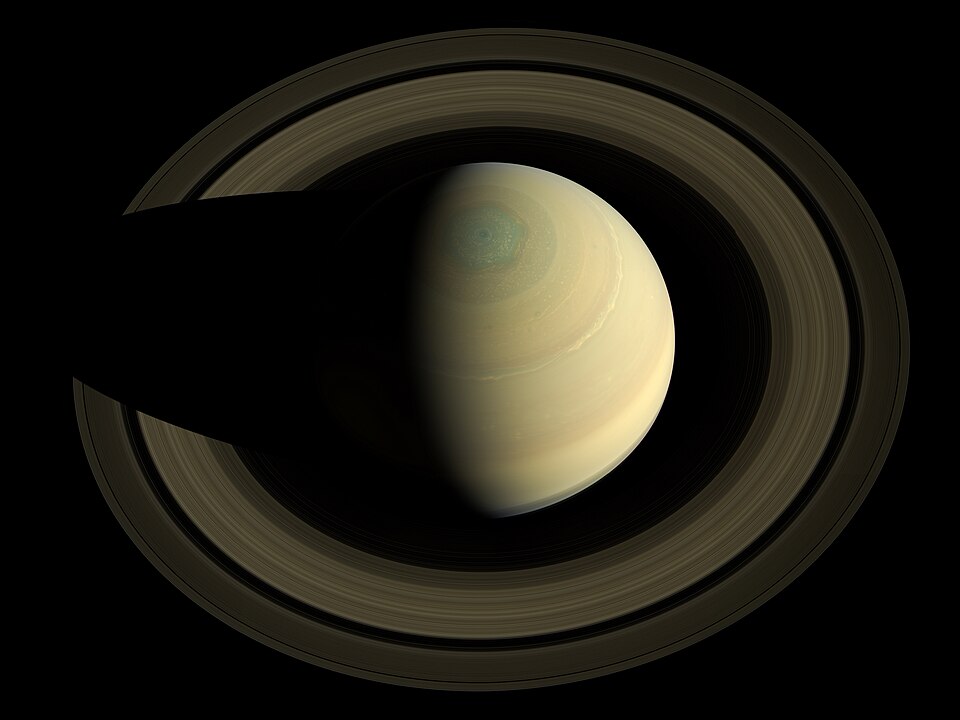
Saturn is massive, with a diameter of about 120,536 kilometers (74,898 miles) at its equator. That means roughly 764 Earths could fit inside Saturn if it were hollow. Despite its huge size, Saturn is actually the least dense planet in our solar system. In fact, Saturn is less dense than water, which means if you could find a bathtub big enough, Saturn would float in it! The planet bulges out at its equator because it spins so quickly.
Saturn’s Rings
Saturn’s rings are made up of billions of pieces of ice, rock, and dust. These pieces range in size from tiny grains of sand to chunks as large as houses or even mountains. The rings stretch out over 280,000 kilometers (174,000 miles) from edge to edge, but they are incredibly thin — only about 10 meters (33 feet) thick in most places. Scientists have identified seven main ring groups, labeled A through G. The Italian astronomer Galileo Galilei first spotted something unusual around Saturn in 1610, but it was Dutch scientist Christiaan Huygens who correctly identified the rings in 1655.
Moons of Saturn
Saturn has at least 146 known moons, giving it more confirmed moons than any other planet in our solar system. Its largest moon, Titan, is bigger than the planet Mercury and is the only moon in the solar system with a thick atmosphere. Titan even has lakes and rivers on its surface, but they are filled with liquid methane and ethane instead of water. Another notable moon is Enceladus, which shoots geysers of water ice from cracks near its south pole. Scientists think Enceladus may have a liquid water ocean beneath its icy surface, making it one of the best places to search for life beyond Earth.
What Saturn Is Made Of
Saturn is a gas giant with no solid surface that you could stand on. Its atmosphere is mostly hydrogen (about 96 percent) and helium (about 3 percent), with small amounts of other gases. Deep inside Saturn, the pressure is so intense that hydrogen gets squeezed into a liquid and eventually into a metallic form. Scientists believe Saturn may have a rocky core at its very center that is about 10 to 20 times the mass of Earth. The planet’s upper atmosphere has bands of clouds and powerful storms, including winds that can reach speeds of 1,800 kilometers per hour (1,118 miles per hour).
Weather and Storms
Saturn has some of the wildest weather in the solar system. Wind speeds near Saturn’s equator can blow at up to 1,800 kilometers per hour, making them among the fastest winds on any planet. About every 20 to 30 years, a massive storm called a Great White Spot appears in Saturn’s atmosphere. These storms can grow large enough to be seen through telescopes from Earth. Saturn also has a mysterious hexagonal storm pattern at its north pole that is large enough to fit four Earths inside it.
Exploring Saturn
Several spacecraft have visited Saturn to study it up close. Pioneer 11 was the first spacecraft to fly past Saturn in 1979, followed by Voyager 1 in 1980 and Voyager 2 in 1981. The most detailed exploration came from the Cassini spacecraft, which orbited Saturn from 2004 to 2017. Cassini made major discoveries about Saturn’s rings, moons, and atmosphere during its 13-year mission. At the end of its mission, Cassini deliberately plunged into Saturn’s atmosphere to protect the planet’s moons from contamination.
Saturn in History and Culture
People have been watching Saturn in the night sky for thousands of years because it is bright enough to see without a telescope. The ancient Romans named the planet after Saturn, their god of agriculture and time. Saturday, the day of the week, gets its name from the planet Saturn. In many ancient cultures, Saturn was considered the most distant planet because Uranus and Neptune had not yet been discovered. Today, Saturn remains one of the most popular planets for stargazers and is a favorite subject for astronomers studying planetary science.
 OtterKnow Kids Encyclopedia