How Space Probes Work
Space probes are launched into space on top of powerful rockets that push them beyond Earth’s gravity. Once in space, a probe uses small thrusters to adjust its direction and speed. Many probes use the gravity of planets to slingshot themselves farther into space, a technique called a gravity assist. Solar panels or nuclear batteries provide the electricity probes need to power their instruments and communicate with Earth. Radio antennas on the probe send signals to large dish antennas on Earth, and even though the signals travel at the speed of light, messages from distant probes can take hours to arrive.
Exploring the Inner Planets
Several space probes have been sent to study Mercury, Venus, and Mars — the planets closest to the Sun along with Earth. NASA’s Mariner 10 was the first probe to visit Mercury in 1974, and the MESSENGER probe orbited Mercury from 2011 to 2015. Venus has been explored by many probes, including the Soviet Venera missions, which actually landed on Venus’s scorching surface. Mars has been explored more than any other planet, with probes like Mars Reconnaissance Orbiter taking detailed photos from orbit while rovers like Curiosity and Perseverance drive across the surface.
Voyager: The Grand Tour
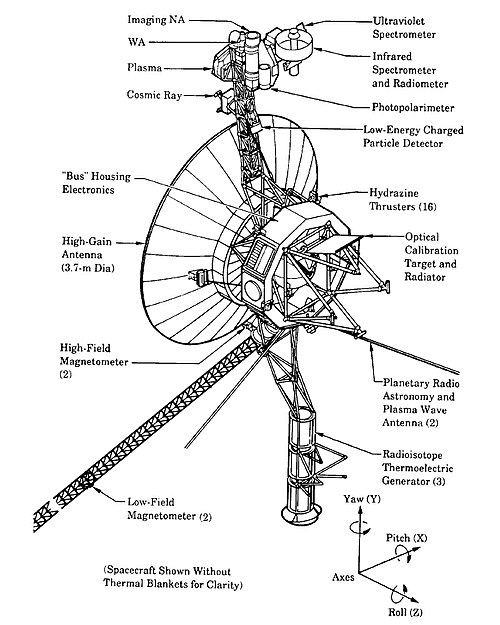
The Voyager 1 and Voyager 2 probes are among the most famous spacecraft ever launched. They left Earth in 1977 and visited Jupiter and Saturn, sending back the first close-up photos of those giant planets and their moons. Voyager 2 continued on to visit Uranus in 1986 and Neptune in 1989, making it the only probe to visit those distant ice giants. Both Voyager probes have now traveled beyond the edge of our solar system into interstellar space. Voyager 1, at over 15 billion miles from Earth, is the farthest human-made object in the universe.
Exploring Jupiter and Saturn
The gas giants Jupiter and Saturn have been studied by several dedicated probes. The Galileo probe orbited Jupiter from 1995 to 2003 and even dropped a smaller probe into Jupiter’s thick atmosphere. NASA’s Juno probe arrived at Jupiter in 2016 and continues to study the planet’s powerful storms, including the Great Red Spot. The Cassini probe spent 13 years orbiting Saturn from 2004 to 2017, discovering geysers of water ice shooting out of Saturn’s moon Enceladus. Cassini also carried the Huygens lander, which touched down on Saturn’s largest moon Titan in 2005 — the farthest landing from Earth ever achieved at that time.
Probes to Comets and Asteroids
Space probes have also visited some of the smaller objects in our solar system. The European Space Agency’s Rosetta probe traveled for ten years before landing on a comet called 67P in 2014. Japan’s Hayabusa2 probe collected samples from the asteroid Ryugu and brought them back to Earth in 2020. NASA’s OSIRIS-REx probe did the same thing with the asteroid Bennu, returning samples to Earth in 2023. These missions help scientists understand what the solar system was made of when it first formed billions of years ago.
New Horizons and the Edge of the Solar System
NASA’s New Horizons probe was launched in 2006 on a mission to explore Pluto, the distant dwarf planet. It arrived at Pluto in July 2015 after a journey of more than 3 billion miles, revealing a world with icy mountains and a heart-shaped glacier. New Horizons then continued deeper into the Kuiper Belt and flew past a small icy object called Arrokoth in 2019. Scientists were surprised to find that Arrokoth looked like a reddish snowman made of two connected pieces. New Horizons continues to travel outward and send data about the distant edges of our solar system.
Why Space Probes Matter
Space probes have completely changed our understanding of the solar system and beyond. They have discovered active volcanoes on Jupiter’s moon Io, underground oceans on Europa and Enceladus, and rivers of liquid methane on Titan. Probes have shown us that Mars once had flowing water on its surface and that Venus has a crushing atmosphere 90 times thicker than Earth’s. Without space probes, we would know very little about the worlds beyond our own planet. Future probes are being planned to search for signs of life on ocean moons and to explore even more distant parts of our solar system.
 OtterKnow Kids Encyclopedia