Pioneer Missions
The Pioneer 10 and Pioneer 11 spacecraft were the first human-made objects to visit the outer planets. Pioneer 10 launched in 1972 and flew past Jupiter in December 1973, sending back the first close-up images of the giant planet and discovering that Jupiter’s radiation belts are extremely strong. Pioneer 11 followed in 1973 and visited both Jupiter and Saturn, becoming the first spacecraft to fly past Saturn in 1979. Both Pioneer spacecraft carried gold-plated plaques with drawings of humans and a map showing Earth’s location, in case alien life ever found them. These missions proved that spacecraft could survive the dangerous asteroid belt and the intense radiation around Jupiter.
The Voyager Grand Tour
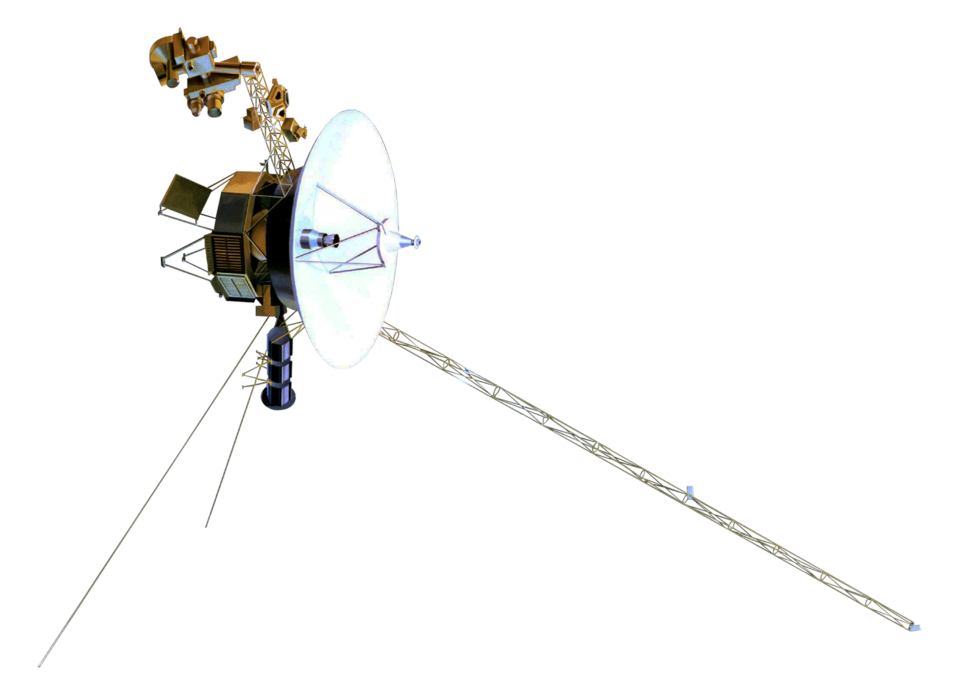
NASA’s Voyager 1 and Voyager 2 spacecraft, launched in 1977, are among the most successful space missions ever. The two Voyagers took advantage of a rare alignment of the outer planets that happens only once every 175 years, allowing them to visit multiple planets using gravity assists. Voyager 1 flew past Jupiter and Saturn, discovering active volcanoes on Jupiter’s moon Io and detailed structures in Saturn’s rings. Voyager 2 is the only spacecraft ever to visit Uranus and Neptune, reaching Uranus in 1986 and Neptune in 1989. Both Voyagers are still sending data from beyond the edge of the solar system, making them the farthest human-made objects from Earth.
The Galileo Mission to Jupiter
The Galileo spacecraft orbited Jupiter from 1995 to 2003, giving scientists their most detailed look at the giant planet and its moons. Unlike the Voyagers, which only flew past Jupiter, Galileo stayed in orbit for eight years and made 34 trips around the planet. One of its biggest discoveries was strong evidence that Jupiter’s moon Europa has a salty ocean beneath its icy surface, which could potentially support life. Galileo also dropped a probe into Jupiter’s atmosphere in December 1995, which transmitted data for about 58 minutes before being crushed by the intense pressure. When the mission ended, controllers deliberately crashed Galileo into Jupiter to prevent it from accidentally contaminating Europa with Earth microbes.
Cassini-Huygens at Saturn
The Cassini-Huygens mission was a partnership between NASA and the European Space Agency that explored Saturn and its moons from 2004 to 2017. Cassini orbited Saturn for 13 years, discovering seven new moons and studying the planet’s ring system in fine detail. One of its most exciting finds was geysers of water ice erupting from the surface of Saturn’s small moon Enceladus, suggesting an underground ocean. The Huygens probe separated from Cassini and landed on Saturn’s largest moon, Titan, in January 2005, becoming the first spacecraft to land in the outer solar system. Titan turned out to have lakes and rivers on its surface, but they are filled with liquid methane instead of water.
The Juno Mission
NASA’s Juno spacecraft arrived at Jupiter in July 2016 and continues to study the planet today. Juno orbits Jupiter in a special path that takes it over the planet’s poles, allowing it to study Jupiter’s deep atmosphere, powerful magnetic field, and internal structure. The spacecraft discovered that Jupiter’s famous Great Red Spot, a storm bigger than Earth, extends much deeper into the atmosphere than scientists expected. Juno also found that Jupiter’s core is not a solid ball of rock as previously thought, but rather a fuzzy mix of heavy elements spread through the planet’s interior. Its cameras have captured detailed images of Jupiter’s swirling cloud patterns that look like paintings.
New Horizons and Beyond
While not technically an outer planet mission, NASA’s New Horizons spacecraft flew past Jupiter in 2007 for a gravity assist on its way to Pluto. It reached Pluto in July 2015, revealing a surprisingly complex world with mountains of ice, glaciers of frozen nitrogen, and a thin atmosphere. After Pluto, New Horizons continued deeper into the Kuiper Belt and flew past a small, snowman-shaped object called Arrokoth in January 2019. Future missions to the outer planets include the Europa Clipper, which launched in 2024 and will study Jupiter’s moon Europa to determine whether its ocean could support life. Scientists are also planning missions to explore Titan and Enceladus, two of Saturn’s moons that could harbor the ingredients for life.
Why Exploring the Outer Planets Matters
Exploring the outer planets teaches us about how our solar system formed and how it has changed over billions of years. The gas giants and their moons are like a laboratory for studying weather, geology, and chemistry on a scale we cannot find on Earth. Discovering oceans on moons like Europa and Enceladus has changed the way scientists think about where life might exist in the universe. These missions also push engineers to develop new technologies, such as nuclear-powered spacecraft that can operate far from the Sun where solar panels would not work. Every mission to the outer planets brings surprises and reminds us how much there is still to discover about our cosmic neighborhood.
 OtterKnow Kids Encyclopedia