How Big Is It?
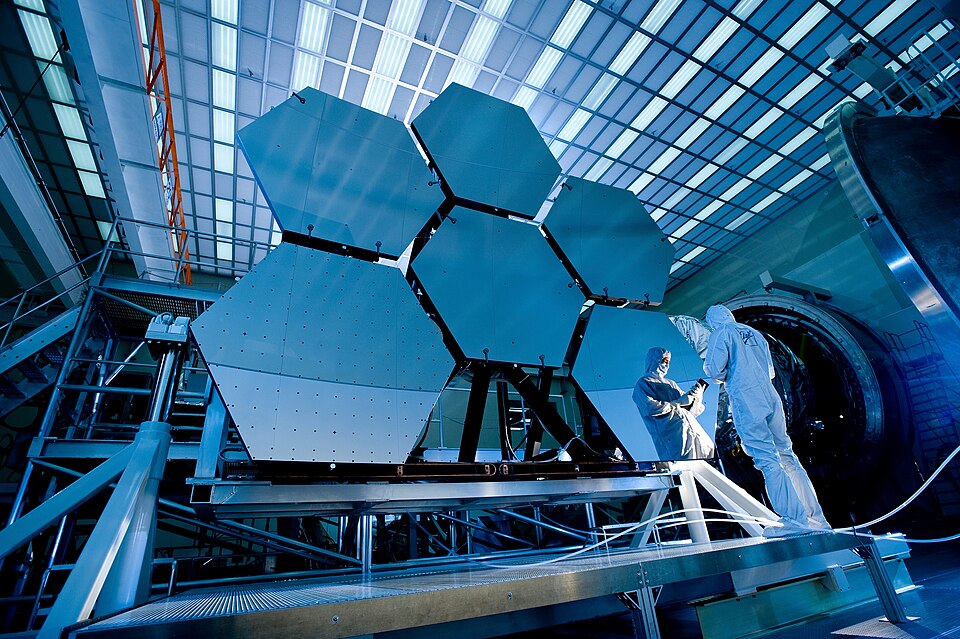
The James Webb Space Telescope is enormous compared to other space telescopes. Its primary mirror is 6.5 meters (about 21 feet) across, which is nearly three times wider than the Hubble Space Telescope’s mirror. The mirror is made up of 18 hexagonal segments coated in a thin layer of gold, which helps it reflect infrared light. Webb also has a sunshield about the size of a tennis court that protects its instruments from the heat of the Sun. The whole telescope had to be folded up like origami to fit inside the rocket that carried it into space.
Where Does It Orbit?
Unlike the Hubble Space Telescope, which orbits close to Earth, Webb orbits the Sun at a special point called the second Lagrange point, or L2. This spot is about 1.5 million kilometers (nearly 1 million miles) from Earth, which is roughly four times farther away than the Moon. At L2, the gravity of the Earth and the Sun work together to let Webb stay in a stable position. This location keeps Webb far from Earth’s heat, which is important because its instruments need to be extremely cold to detect faint infrared light. It took about 30 days for Webb to travel from Earth to its orbit at L2.
Seeing in Infrared Light
One of the things that makes Webb special is that it sees the universe in infrared light, which is a type of light that human eyes cannot see. Infrared light is sometimes called “heat radiation” because warm objects give it off. By detecting infrared light, Webb can peer through thick clouds of dust and gas where new stars are being born. It can also see very distant galaxies whose light has been stretched into infrared wavelengths as the universe expands. To work properly, Webb’s instruments must be cooled to about minus 233 degrees Celsius (minus 387 degrees Fahrenheit).
What Webb Has Found
Since it started working, the James Webb Space Telescope has made many exciting discoveries. It has captured the deepest and sharpest images of the distant universe ever taken, showing galaxies that formed just a few hundred million years after the Big Bang. Webb has also studied the atmospheres of planets orbiting other stars, called exoplanets, and found gases like carbon dioxide and water vapor in their atmospheres. It has revealed fine details inside nebulae, which are giant clouds of gas and dust where stars are born. Scientists around the world use Webb’s data to answer big questions about how the universe works.
How It Was Built
Building the James Webb Space Telescope took more than 20 years and cost about 10 billion dollars. Thousands of scientists and engineers from 14 countries worked together to design and construct it. One of the biggest challenges was making sure every part would unfold perfectly in space, since there was no way to send astronauts to fix it at its distant orbit. The team tested every piece over and over again to make sure nothing would go wrong. The telescope was originally planned to launch in 2007, but its complex design led to many delays before it finally lifted off in 2021.
Webb vs. Hubble
The Hubble Space Telescope launched in 1990 and changed our understanding of the universe, so many people wonder how Webb compares. While Hubble mainly sees visible light and some ultraviolet light, Webb focuses on infrared light, so they study different things. Webb’s much larger mirror collects about six times more light than Hubble’s, allowing it to see fainter and more distant objects. The two telescopes actually work together, with Hubble finding interesting targets that Webb can then study in greater detail. Hubble orbits just 547 kilometers above Earth, while Webb is nearly 1.5 million kilometers away.
Why It Matters
The James Webb Space Telescope is helping humanity answer some of the biggest questions we have ever asked. By looking back in time to when the first galaxies formed, it teaches us about the history of the universe itself. Its studies of exoplanet atmospheres bring us closer to knowing whether life exists somewhere else in the universe. Webb inspires millions of people around the world, showing what is possible when countries work together on a shared scientific goal. The telescope is expected to keep making discoveries for at least 20 years, thanks to the fuel it saved during its precise launch.
 OtterKnow Kids Encyclopedia