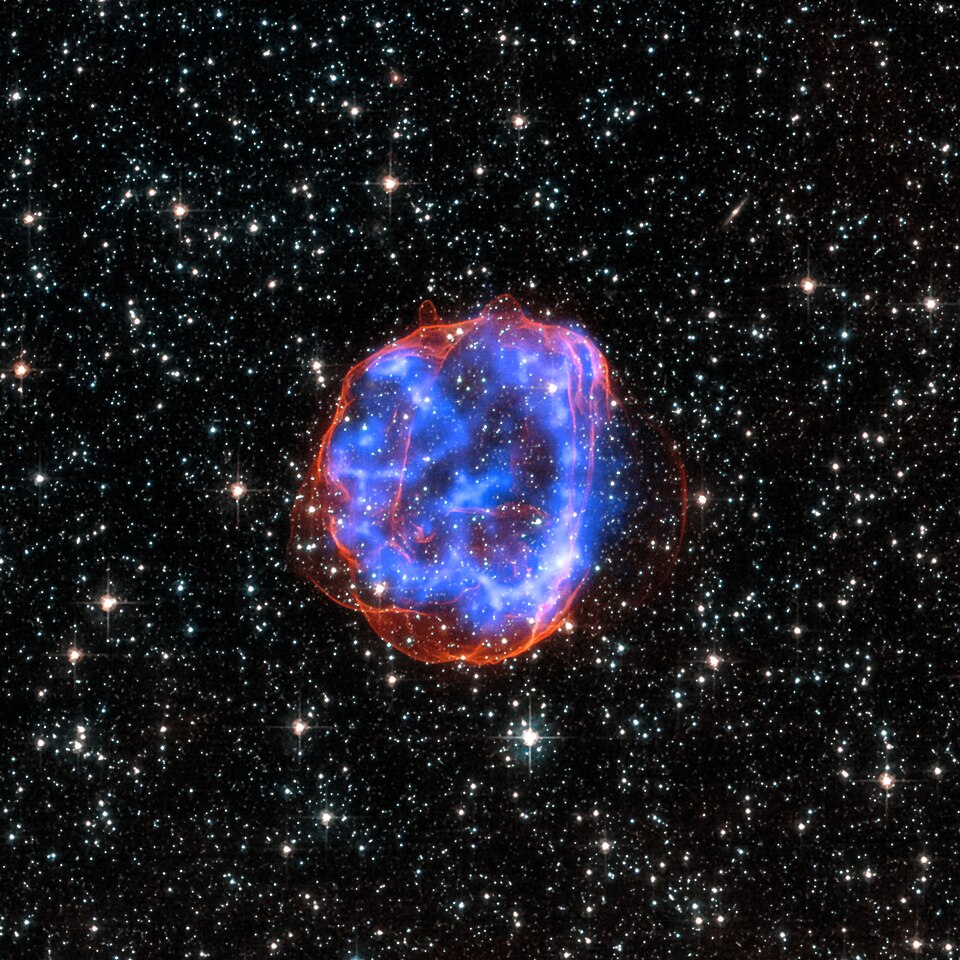
How a Supernova Happens
A supernova begins when a massive star, at least eight times heavier than our Sun, runs out of fuel in its core. Throughout its life, the star’s core fused lighter elements into heavier ones, starting with hydrogen and working up to iron. Iron cannot release energy through fusion, so when the core becomes mostly iron, fusion stops and there is nothing to hold up the star against gravity. The core collapses in less than a second, and the outer layers crash inward and then bounce back outward in a tremendous explosion. The temperature during this collapse can reach 100 billion degrees, which is hotter than the center of any star.
Types of Supernovae
Scientists have identified two main types of supernovae. Type II supernovae happen when a single massive star collapses at the end of its life, which is the process described above. Type Ia supernovae happen in a two-star system where a white dwarf pulls matter from a companion star until it reaches a critical mass and explodes. Type Ia supernovae are especially useful to astronomers because they always explode with about the same brightness, making them excellent tools for measuring distances across the universe. Both types release enormous amounts of energy, but they happen for very different reasons.
What Supernovae Create
Supernovae are like giant element factories. During the explosion, the extreme heat and pressure create heavy elements such as gold, silver, platinum, and uranium that cannot be made inside ordinary stars. These elements are blasted into space, where they mix with clouds of gas and dust. Over millions of years, this enriched material can clump together to form new stars, planets, and even the building blocks of life. Almost every element heavier than iron found on Earth was created in a supernova explosion billions of years ago.
Famous Supernovae in History
People have been observing supernovae for thousands of years, even before they understood what they were. In the year 1054, Chinese astronomers recorded a “guest star” that was bright enough to see during the daytime for 23 days. The remains of that explosion are now called the Crab Nebula. In 1572, the Danish astronomer Tycho Brahe observed a supernova that challenged the belief that the heavens never changed. The most recent supernova visible to the naked eye was SN 1987A, which exploded in a nearby galaxy called the Large Magellanic Cloud and was spotted by astronomers in February 1987.
Supernova Remnants
After a supernova explosion, the material that was blasted outward does not simply disappear. It forms a beautiful, expanding cloud of gas and dust called a supernova remnant. These remnants can glow for thousands of years as the hot gas crashes into the surrounding space. The Crab Nebula, the remnant of the 1054 supernova, is one of the most studied objects in astronomy. Supernova remnants also send out powerful shock waves that can trigger the formation of new stars by squeezing nearby gas clouds together.
Neutron Stars and Black Holes
What happens to the core of a star after a supernova depends on how massive it was. If the remaining core is between about 1.4 and 3 times the mass of our Sun, it becomes a neutron star. Neutron stars are incredibly dense, packing more mass than the Sun into a ball only about 12 miles across. A teaspoon of neutron star material would weigh about 6 billion tons on Earth. If the leftover core is more than about 3 times the Sun’s mass, gravity crushes it into a black hole, an object so dense that not even light can escape from it.
Why Supernovae Matter
Supernovae play a vital role in the story of our universe and our own existence. They spread the heavy elements needed for rocky planets and living things across space. Without supernovae, Earth would not have the iron in its core, the oxygen in its atmosphere, or the carbon in every living cell. Astronomers also use Type Ia supernovae as “standard candles” to measure how far away distant galaxies are, which led to the discovery in 1998 that the universe is expanding faster and faster. Studying supernovae helps scientists understand both the past and the future of the universe.
 OtterKnow Kids Encyclopedia