Born in a Nebula
Stars begin their lives inside enormous clouds of gas and dust called nebulae. These clouds are made mostly of hydrogen, the lightest and most common element in the universe. Over millions of years, gravity pulls clumps of gas and dust closer together, causing them to heat up. As the material squeezes tighter and tighter, it forms a spinning ball called a protostar. The Orion Nebula, which is visible from Earth, is one of the most famous places where new stars are being born right now.
Becoming a Main Sequence Star
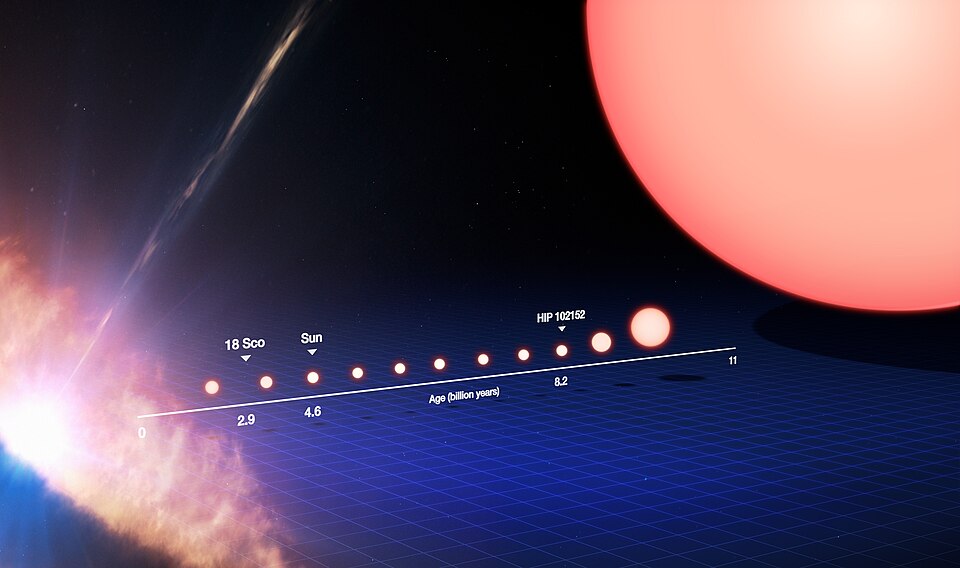
When a protostar gets hot enough, a process called nuclear fusion begins in its core. Nuclear fusion happens when hydrogen atoms smash together and combine to form helium, releasing tremendous amounts of energy. This energy is what makes stars shine so brightly. Once fusion begins, the star enters the longest stage of its life, called the main sequence. Our Sun has been a main sequence star for about 4.6 billion years and will remain one for roughly another 5 billion years.
How a Star’s Mass Matters
The mass of a star, meaning how much matter it contains, determines almost everything about its life. Stars with low mass burn their fuel slowly and can shine for hundreds of billions of years. Medium-mass stars like our Sun live for about 10 billion years. Massive stars, which can be 10 to 50 times heavier than the Sun, burn through their fuel much faster and may only live for a few million years. It might seem backward, but the biggest stars actually have the shortest lives because they use up their fuel so quickly.
Red Giants and Supergiants
When a medium-mass star runs out of hydrogen fuel in its core, it begins to swell up and cool down, turning into a red giant. A red giant can grow to be hundreds of times larger than the original star. When our Sun becomes a red giant in about 5 billion years, it will expand so much that it could swallow Mercury and Venus. Massive stars swell even larger and become supergiants, which are among the biggest objects in the entire universe. The star Betelgeuse in the constellation Orion is a red supergiant that is about 700 times wider than our Sun.
White Dwarfs and Planetary Nebulae
After a medium-mass star finishes its time as a red giant, its outer layers drift away into space, forming a beautiful glowing shell called a planetary nebula. The hot core left behind is called a white dwarf, which is roughly the size of Earth but incredibly dense. A teaspoon of white dwarf material would weigh about as much as a car on Earth. White dwarfs no longer produce energy through fusion, so they slowly cool down over billions of years. Eventually, they fade and become cold, dark objects sometimes called black dwarfs, though the universe is not yet old enough for any to exist.
The Explosive End of Massive Stars
Stars much more massive than our Sun meet a far more dramatic end. When a massive star runs out of fuel, its core collapses in just seconds, triggering a massive explosion called a supernova. A single supernova can briefly outshine an entire galaxy of billions of stars. The explosion scatters heavy elements like iron, gold, and carbon into space, and these elements eventually become part of new stars, planets, and even living things. After a supernova, the leftover core can become either a neutron star or, if massive enough, a black hole.
Why Star Life Cycles Matter to Us
The life cycles of stars are directly connected to life on Earth. Almost every element heavier than hydrogen and helium was created inside stars or during supernova explosions. The calcium in your bones, the iron in your blood, and the oxygen you breathe were all forged in stars that lived and died long before our Sun was born. Scientists sometimes say that we are all made of “star stuff.” By studying stars at different stages of their lives, astronomers can also predict what will happen to our own Sun billions of years from now.
 OtterKnow Kids Encyclopedia