Red Dwarf Stars
Red dwarf stars are the smallest and coolest type of star, with surface temperatures between about 3,000 and 5,000 degrees Fahrenheit. They are also the most common stars in the universe — scientists estimate that about 70 percent of all stars are red dwarfs. Because they burn their fuel very slowly, red dwarfs can shine for trillions of years, much longer than any other type of star. Proxima Centauri, the closest star to our Sun, is a red dwarf. Despite being so common, red dwarfs are too dim to see with the naked eye from Earth.
Yellow Dwarf Stars
Our Sun is a yellow dwarf star, which is a medium-sized star with a surface temperature of about 10,000 degrees Fahrenheit. Yellow dwarfs are not actually yellow — from space, they appear white, but Earth’s atmosphere makes the Sun look yellowish. These stars typically shine for about 10 billion years before running out of hydrogen fuel. When a yellow dwarf runs out of fuel, it swells up into a red giant before shedding its outer layers and becoming a white dwarf. Yellow dwarfs are important to astronomers because planets orbiting them may have the right conditions for life.
Red Giant and Supergiant Stars
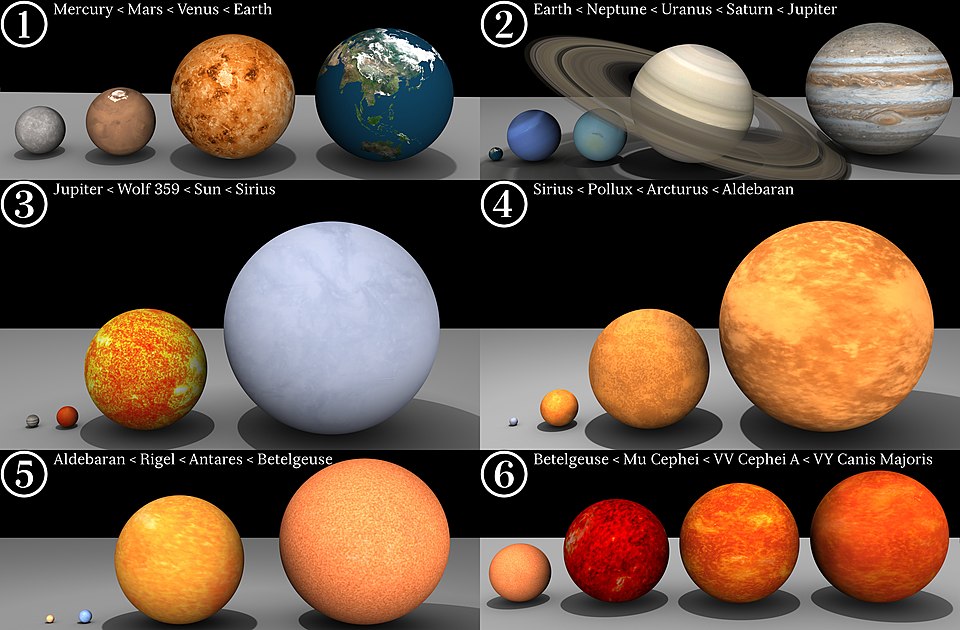
When a star like our Sun begins to run out of hydrogen fuel, it expands into an enormous red giant. Red giants can grow to be 100 times the diameter of the Sun, large enough to swallow the inner planets of a solar system. Betelgeuse, a famous red supergiant in the constellation Orion, is about 700 times the diameter of the Sun. Red supergiants are even larger and more massive than red giants, and they burn through their fuel much faster. These massive stars end their lives in spectacular explosions called supernovae.
Blue Giant Stars
Blue giant stars are among the hottest and brightest stars in the universe, with surface temperatures that can exceed 36,000 degrees Fahrenheit. They are much larger and more massive than our Sun, often 10 to 50 times heavier. Because they are so hot, blue giants burn through their hydrogen fuel very quickly and may only live for a few million years. Rigel, a blue supergiant in the constellation Orion, is about 120,000 times brighter than our Sun. Although blue giants are rare compared to red dwarfs, they are so bright that they can be seen from very far away.
White Dwarf Stars
A white dwarf is what remains after a medium-sized star like our Sun reaches the end of its life. When the star runs out of fuel and sheds its outer layers, the hot, dense core left behind is called a white dwarf. White dwarfs are roughly the size of Earth but contain nearly as much mass as the Sun, making them incredibly dense. A teaspoon of white dwarf material would weigh about 15 tons on Earth. Over billions of years, a white dwarf slowly cools down and fades, eventually becoming a cold, dark object called a black dwarf.
Neutron Stars
Neutron stars form when a massive star — much bigger than our Sun — explodes in a supernova. After the explosion, the star’s core collapses into an incredibly small and dense object only about 12 miles across. Neutron stars are so dense that a single teaspoon of their material would weigh about 6 billion tons. Some neutron stars spin very rapidly and send out beams of light, earning them the name pulsars. The fastest known pulsars spin hundreds of times per second, which is faster than a kitchen blender.
How Astronomers Classify Stars
Astronomers use a system called the Hertzsprung-Russell diagram to organize stars by their temperature and brightness. This diagram was created in the early 1900s by two scientists, Ejnar Hertzsprung and Henry Norris Russell. On the diagram, hot blue stars appear on the left side and cool red stars appear on the right. Most stars, including our Sun, fall along a band called the main sequence, where they spend most of their lives. By plotting a star on this diagram, astronomers can figure out what stage of life the star is in and predict how it will change in the future.
 OtterKnow Kids Encyclopedia