New Moon
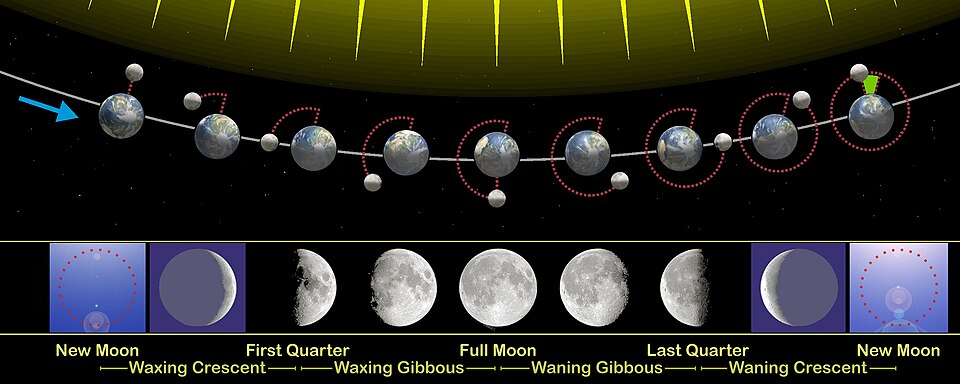
The new moon phase happens when the Moon is positioned between the Earth and the Sun. During a new moon, the sunlit side of the Moon faces away from Earth, so we cannot see it in the sky. The sky appears moonless on these nights, making it the darkest time of the month. New moons are the best time for stargazing because there is no moonlight to wash out the dimmer stars. Occasionally, a new moon lines up perfectly with the Sun and causes a solar eclipse.
Waxing Crescent and First Quarter
After the new moon, a thin sliver of light appears on the right side of the Moon, which is called the waxing crescent. The word “waxing” means growing, because the lit portion of the Moon gets bigger each night. About a week after the new moon, the Moon reaches its first quarter phase, when exactly half of the Moon’s face appears lit. The first quarter moon rises around noon and sets around midnight. During this phase, you can sometimes see the Moon in the afternoon sky while the Sun is still up.
Waxing Gibbous
After the first quarter, the Moon continues to grow brighter in a phase called waxing gibbous. The word “gibbous” comes from a Latin word meaning “humpbacked,” which describes the Moon’s rounded shape during this phase. More than half of the Moon’s face is now lit, and it gets a little fuller each night. The waxing gibbous moon rises in the afternoon and stays visible for most of the night. This phase lasts about a week as the Moon moves toward becoming completely full.
Full Moon
A full moon occurs when Earth is positioned between the Sun and the Moon, allowing the entire face of the Moon to be lit up. Full moons rise around sunset and set around sunrise, so they are visible all night long. Many cultures around the world have given special names to each month’s full moon, such as the Harvest Moon in September or the Wolf Moon in January. A full moon can sometimes pass through Earth’s shadow, creating a lunar eclipse that makes the Moon appear reddish. The full moon is the brightest phase and can cast enough light to create shadows on the ground.
Waning Gibbous and Third Quarter
After the full moon, the lit portion begins to shrink in a phase called waning gibbous. The word “waning” means getting smaller, which is the opposite of waxing. About three weeks after the new moon, the Moon reaches its third quarter phase, also called the last quarter. During the third quarter, the left half of the Moon’s face appears lit, which is the opposite of the first quarter. The third quarter moon rises around midnight and can often be seen in the morning sky after sunrise.
Waning Crescent
The waning crescent is the final phase before the cycle starts over with another new moon. During this phase, only a thin sliver of light remains on the left side of the Moon. The waning crescent moon rises in the early morning hours, a few hours before the Sun comes up. Each night, the crescent gets thinner and thinner until the Moon seems to disappear entirely. Then the cycle begins again with a new moon, and the whole 29.5-day journey repeats.
Why Moon Phases Matter
Moon phases have been important to people throughout history for farming, fishing, and religious celebrations. Many farmers traditionally planted crops based on the phases of the Moon, and some fishers plan their trips around full and new moons when tides are strongest. The Islamic calendar is a lunar calendar, meaning its months are based entirely on the Moon’s phases. Scientists and astronauts also pay attention to moon phases when planning space missions. Understanding moon phases helps us appreciate how the movements of the Earth, Moon, and Sun are all connected.
 OtterKnow Kids Encyclopedia