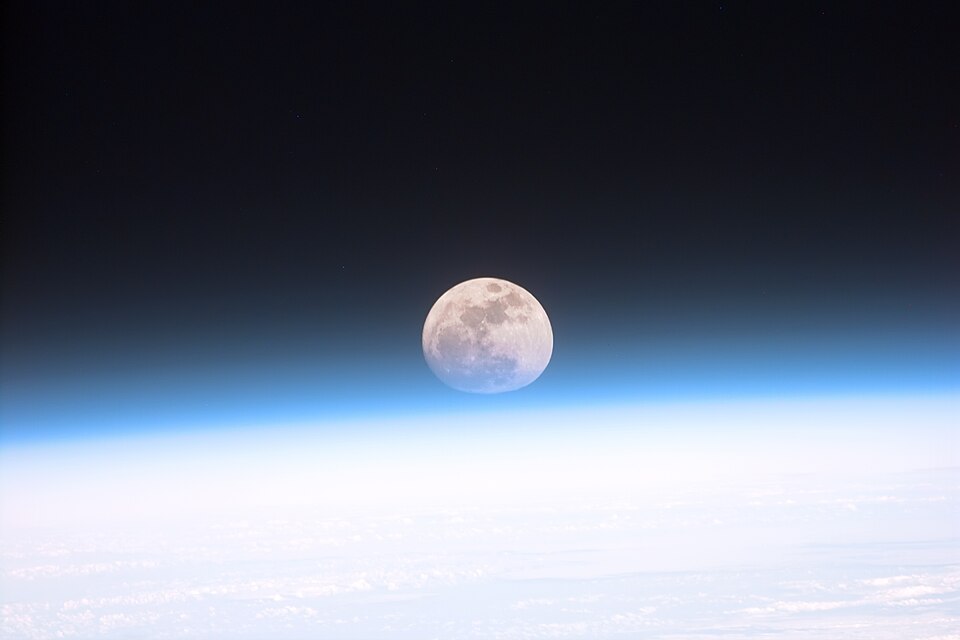
Scientists believe the Moon formed about 4.5 billion years ago after a Mars-sized object crashed into the young Earth. This giant impact theory says the collision sent huge amounts of rock and debris flying into space. Over time, gravity pulled that debris together to form the Moon. This is why the Moon’s rocks are very similar to rocks found on Earth. The impact was so powerful that it may have tilted Earth on its axis, which is what gives us our seasons.
The Moon’s Surface
The Moon’s surface is covered with craters, mountains, and flat plains called maria. These craters were created by asteroids and meteorites smashing into the Moon over billions of years. The largest crater on the Moon, the South Pole-Aitken basin, is about 1,550 miles (2,500 kilometers) across. The Moon has no atmosphere to protect it, so even tiny space rocks leave marks on its surface. There is also no wind or rain on the Moon, which means footprints left by astronauts are still there today.
Gravity on the Moon
The Moon is much smaller than Earth, so its gravity is only about one-sixth as strong as Earth’s gravity. This means if you weigh 60 pounds on Earth, you would weigh only about 10 pounds on the Moon. Astronauts who visited the Moon could jump much higher and bounce with each step they took. The Moon’s weaker gravity is also why it has no atmosphere, because it cannot hold onto gas molecules the way Earth can. Despite its weaker pull, the Moon’s gravity is strong enough to cause ocean tides on Earth.
The Moon and Tides
The Moon’s gravitational pull is the main reason Earth has ocean tides. As the Moon orbits Earth, it pulls on the water in the oceans, creating bulges of water on the side of Earth closest to the Moon and on the opposite side. These bulges cause high tides, while the areas in between experience low tides. Most coastlines experience two high tides and two low tides every day. The Sun also affects tides, but the Moon has about twice as much influence because it is so much closer to Earth.
Exploring the Moon
Humans have been fascinated by the Moon for thousands of years, but the first spacecraft to reach it was the Soviet Union’s Luna 2 in 1959. On July 20, 1969, NASA’s Apollo 11 mission made history when astronauts Neil Armstrong and Buzz Aldrin became the first humans to walk on the Moon. In total, twelve astronauts walked on the Moon during six Apollo missions between 1969 and 1972. They brought back about 842 pounds (382 kilograms) of Moon rocks and soil for scientists to study. NASA’s Artemis program plans to send astronauts back to the Moon in the coming years.
The Moon’s Importance to Earth
The Moon plays a very important role in making Earth a good place to live. Its gravitational pull helps stabilize Earth’s tilt, which keeps our seasons relatively steady over long periods of time. Without the Moon, Earth might wobble wildly on its axis, causing extreme weather changes. The Moon also slows down Earth’s rotation, making our days longer than they would be otherwise. Billions of years ago, a day on Earth was only about six hours long, but the Moon’s gravity has gradually slowed our planet’s spin.
Fun Facts About the Moon
The Moon is slowly moving away from Earth at a rate of about 1.5 inches (3.8 centimeters) per year. Even though we call it “the Moon,” many other planets in our solar system have moons too, and Jupiter alone has at least 95 known moons. The Moon has no light of its own and only shines because it reflects sunlight. The temperature on the Moon can range from 260 degrees Fahrenheit (127 degrees Celsius) during the day to negative 280 degrees Fahrenheit (negative 173 degrees Celsius) at night. A person standing on the Moon would see a pitch-black sky even during the daytime because there is no atmosphere to scatter light.
 OtterKnow Kids Encyclopedia