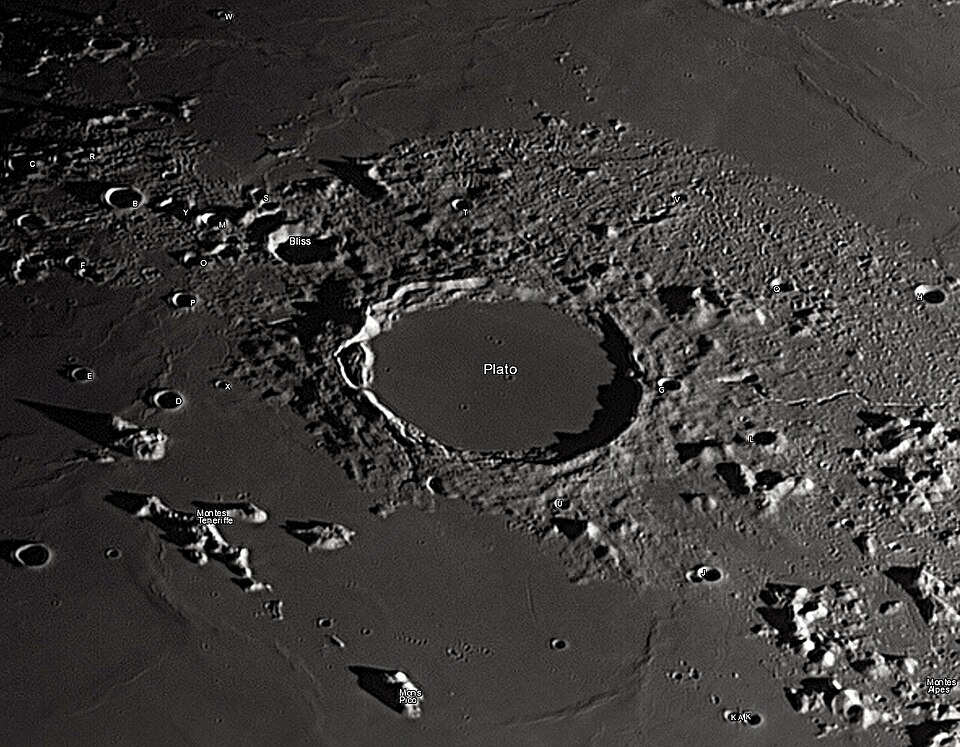
Craters Everywhere
The Moon’s surface is covered with thousands of craters of all sizes. These craters were formed when asteroids, meteoroids, and comets crashed into the Moon over billions of years. Because the Moon has no atmosphere to burn up incoming space rocks, even small objects can slam into the surface and leave a mark. Some craters are tiny, while others are hundreds of kilometers wide. The largest known crater, the South Pole-Aitken Basin, stretches about 2,500 kilometers across and is one of the biggest impact craters in the entire solar system.
The Lunar Highlands
The bright, mountainous areas on the Moon are called the lunar highlands. These regions are the oldest parts of the Moon’s surface, dating back more than 4 billion years. The highlands are made mostly of a light-colored rock called anorthosite. They are heavily cratered because they have been exposed to space rock impacts for so long. Some of the mountains in the highlands rise as high as 5,000 meters, which is taller than most mountains in the Alps on Earth.
The Maria: Dark Plains
The dark, smooth areas on the Moon are called maria, and they formed when ancient volcanoes erupted and flooded low-lying areas with lava. This lava cooled and hardened into a dark rock called basalt. Most of the maria are found on the side of the Moon that faces Earth, which is called the near side. The largest mare is called Oceanus Procellarum, or the Ocean of Storms, and it covers a vast area of the Moon’s near side. The maria are younger than the highlands, but they are still about 3 to 3.5 billion years old.
Moon Dust and Regolith
The entire Moon is covered in a layer of fine, powdery dust and broken rock called regolith. This layer was created over billions of years as meteorite impacts shattered the surface rock into smaller and smaller pieces. The regolith is typically 4 to 5 meters deep on the maria and can be 10 to 15 meters deep on the highlands. Apollo astronauts who walked on the Moon described the dust as feeling like soft, fine powder that stuck to everything. The dust was so clingy that it coated their spacesuits and was difficult to brush off.
No Air, No Weather
The Moon has almost no atmosphere, which means there is no air, no wind, and no weather. Without an atmosphere, the Moon’s surface experiences extreme temperature changes. During the lunar day, temperatures can soar to about 127 degrees Celsius (260 degrees Fahrenheit), while at night they plunge to about minus 173 degrees Celsius (minus 280 degrees Fahrenheit). Because there is no wind or rain, the footprints left by Apollo astronauts in the 1960s and 1970s are still there today, perfectly preserved in the lunar dust.
Water Ice on the Moon
For a long time, scientists believed the Moon was completely dry. However, spacecraft missions have discovered evidence of water ice hiding in deep craters near the Moon’s north and south poles. These craters are permanently shadowed, meaning sunlight never reaches their floors, so temperatures stay cold enough for ice to survive. NASA’s LCROSS mission in 2009 confirmed the presence of water ice at the Moon’s south pole. This discovery is exciting because future astronauts could potentially use this ice for drinking water, growing plants, or even making rocket fuel.
Exploring the Moon’s Surface
Humans have visited the Moon six times during NASA’s Apollo program between 1969 and 1972. A total of twelve astronauts walked on the lunar surface and brought back about 382 kilograms of Moon rocks and soil samples for scientists to study. Since then, robotic spacecraft from several countries have continued to explore the Moon from orbit and on the ground. China’s Chang’e missions have landed rovers on both the near side and the far side of the Moon. Many countries are now planning new missions to send astronauts back to the Moon, including NASA’s Artemis program.
 OtterKnow Kids Encyclopedia