Species
The common hippopotamus is the larger and more well-known of the two species. It lives in rivers, lakes, and wetlands across sub-Saharan Africa, from countries like Kenya and Tanzania to Zambia and Uganda. The pygmy hippopotamus is a much rarer animal that lives in the forests and swamps of West Africa, mainly in Liberia, Sierra Leone, and Guinea. Pygmy hippos weigh only about 200 to 275 kilograms (440 to 605 pounds), which is roughly one-tenth the size of their larger relatives. While common hippos are social and live in groups, pygmy hippos tend to be solitary and are most active at night.
Size and Appearance
Common hippos are massive animals, ranking as the third-heaviest land mammals after elephants and white rhinoceroses. Adult males typically weigh around 1,500 to 1,800 kilograms (3,300 to 4,000 pounds), though some large males can reach over 3,000 kilograms. They stand about 1.5 meters (5 feet) tall at the shoulder and can measure up to 3.5 meters (11.5 feet) in length. Their skin is thick and mostly hairless, usually grayish-brown with pinkish patches around the eyes, ears, and belly. One of their most striking features is their enormous mouth, which can open to nearly 180 degrees and reveal canine teeth that grow up to 50 centimeters (20 inches) long.
Life in the Water
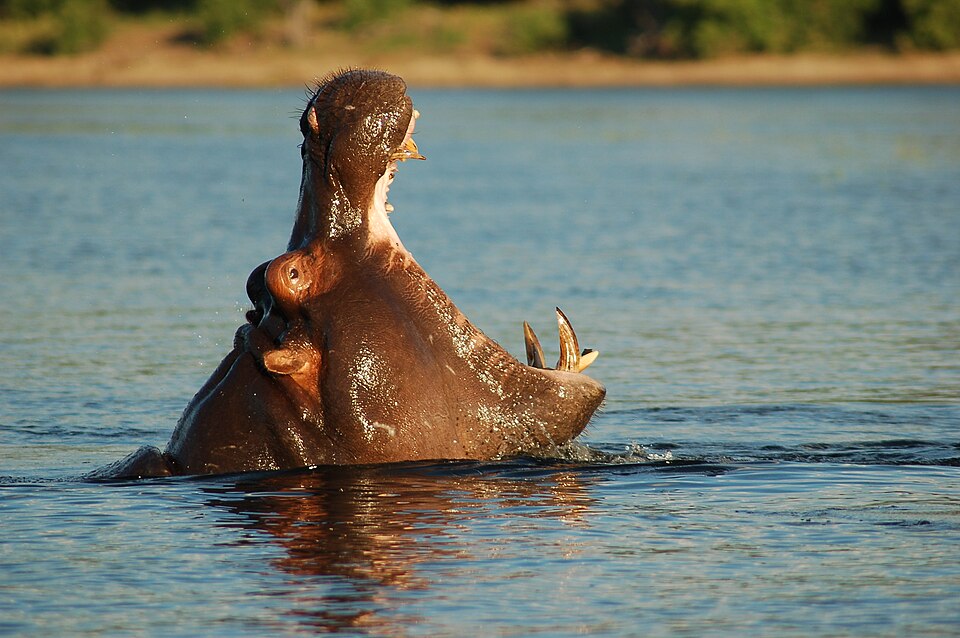
Hippos are semiaquatic, meaning they split their time between water and land. They spend up to 16 hours each day resting in rivers or lakes to keep their massive bodies cool under the hot African sun. Their eyes, ears, and nostrils sit on top of their heads, so they can see, hear, and breathe while the rest of their body stays hidden beneath the surface. Hippos can hold their breath and stay completely underwater for up to five minutes. They do not actually swim by paddling; instead, they walk or bounce along the bottom of rivers and lakes, pushing off the riverbed with their feet.
Built-In Sunscreen
One of the hippopotamus’s most remarkable adaptations is a natural sunscreen. Hippos produce a thick, oily secretion from special glands in their skin that starts out clear but quickly turns reddish-orange in the sunlight. Scientists once thought hippos were sweating blood, but the substance is neither sweat nor blood. Researchers have found that it contains two pigments called hipposudoric acid and norhipposudoric acid, which absorb ultraviolet light and protect the hippo’s sensitive skin from sunburn. This natural coating also has antibacterial properties, helping to keep wounds clean in the murky water where hippos spend their days.
Diet
Despite their fierce reputation, hippos are herbivores. They eat mostly short grasses, which they crop with their wide, muscular lips. Each evening at dusk, hippos leave the water and walk along well-worn paths to their grazing areas, sometimes traveling several kilometers in a single night. An adult hippo eats about 35 to 40 kilograms (80 to 90 pounds) of grass per night, which is actually a modest amount for an animal of its size. They rarely eat aquatic plants, and unlike many other large herbivores, they do not browse on leaves or shrubs. Their digestive systems are specially adapted to extract as much nutrition as possible from their grassy diet.
Social Behavior
Common hippos are social animals that live in groups called pods, bloats, or herds, typically made up of 10 to 30 individuals. These groups usually consist of females and their young, overseen by a dominant male known as the bull. The bull defends a stretch of river or lakeshore as his territory, and he uses loud bellowing calls, yawning displays that show off his enormous teeth, and dung-spreading to mark his boundaries. Territorial fights between rival males can be violent and sometimes deadly, as the hippos slash at each other with their long canine teeth. Females are generally calmer and cooperate to protect their young calves from predators like crocodiles.
Baby Hippos
Female hippos give birth to a single calf after a pregnancy of about eight months. Remarkably, hippo calves are often born underwater and must swim to the surface to take their first breath. Newborns weigh between 25 and 50 kilograms (55 to 110 pounds) and can nurse both on land and underwater by closing their ears and nostrils. Mothers are fiercely protective and keep their calves close for the first several months. Young hippos stay with their mothers for six to eight years before becoming fully independent. In the wild, hippos can live for 40 to 50 years.
Threats and Conservation
The common hippopotamus is listed as Vulnerable by the International Union for Conservation of Nature (IUCN), with a population estimated at 115,000 to 130,000 animals. The pygmy hippopotamus is in far greater danger and is classified as Endangered, with fewer than 2,500 adults believed to remain in the wild. The main threats to both species include habitat loss as wetlands are drained for farming, illegal hunting for meat and ivory-like canine teeth, and water pollution. In some parts of Africa, conflicts between hippos and farmers have increased as human settlements expand into hippo territory. Conservation efforts focus on protecting river and lake habitats, enforcing anti-poaching laws, and reducing conflict between hippos and the communities that live near them.
 OtterKnow Kids Encyclopedia