Size and Appearance
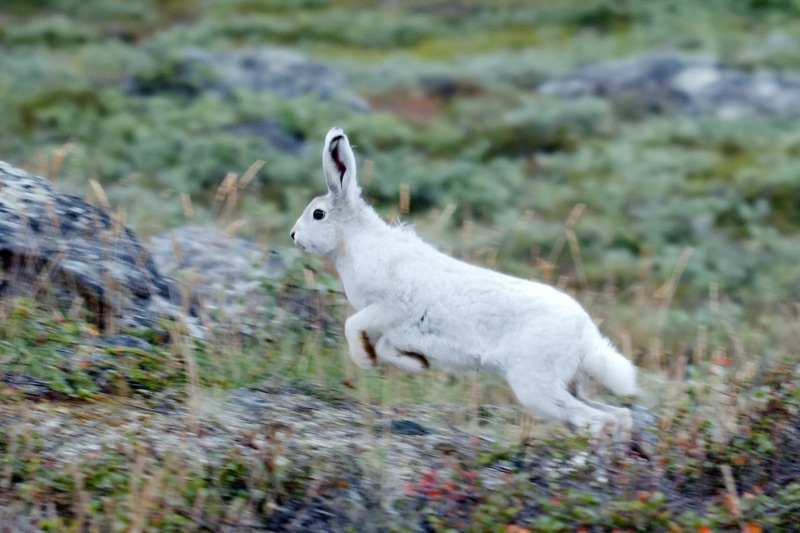
Arctic hares are much larger than the rabbits you might see in a backyard. They can measure 43 to 70 centimeters (17 to 28 inches) long, not counting their short tail, and they weigh between 2.5 and 5.5 kilograms (6 to 12 pounds). Some especially large individuals can weigh up to 7 kilograms (about 15 pounds). Their ears are shorter than those of most other hares, which helps them hold on to body heat. They also have thick, padded paws that work like snowshoes, spreading their weight so they can walk on top of deep snow.
A Coat That Changes Color
One of the most interesting things about the Arctic hare is how its fur changes with the seasons. In the far north, where winters are long and snow covers the ground nearly all year, Arctic hares stay white year-round. Farther south, in places like Newfoundland and southern Labrador, their fur turns brownish-gray in summer to blend in with rocks and soil, then shifts back to pure white in winter. This seasonal color change, called molting, gives them excellent camouflage against predators no matter the time of year.
Built for the Cold
Arctic hares have an impressive set of adaptations for surviving extreme cold. About 20 percent of their body weight comes from a thick layer of fat that acts as insulation. Their compact shape, with short ears, a small nose, and sturdy limbs, reduces the amount of skin exposed to freezing air. They often dig shallow holes in the ground or burrow under snow to shelter from harsh winds. When resting, they tuck their legs and ears close to their body and turn their back to the wind, conserving as much warmth as possible.
What They Eat
Arctic hares are mainly herbivores, meaning they eat plants. Their diet includes mosses, lichens, woody plants, berries, buds, roots, bark, and even seaweed when they can find it near the coast. In winter, they use their strong claws to dig through hard-packed snow to reach buried plants. They can also be opportunistic eaters, occasionally feeding on whatever food sources are available in their harsh environment. Finding enough food on the barren tundra is a constant challenge, but their ability to eat such a wide variety of plants helps them survive.
Speed
Despite their stocky build, Arctic hares are surprisingly fast. When running on all four legs, they can reach speeds of up to 60 kilometers per hour (about 40 miles per hour), which is fast enough to outrun many predators. They can also hop upright on just their hind legs, covering ground at around 48 kilometers per hour (30 miles per hour). This unusual two-legged hopping looks almost like a kangaroo bounding across the snow and helps them move quickly when they sense danger.
Flocking Together
Most hares are solitary animals, but Arctic hares have a very unusual social behavior. During winter, they gather in large groups called flocks. These flocks can include dozens, hundreds, or even thousands of hares huddled together on the open tundra. Gathering in such large numbers serves two purposes: it helps them stay warm through shared body heat, and it gives them better protection from predators. With so many eyes and ears watching for danger, a predator is much less likely to sneak up on the group unnoticed.
Predators and Threats
Arctic hares must stay alert because several predators hunt them across the tundra. The arctic fox is one of their most common enemies, along with wolves, lynx, and ermine. From the sky, snowy owls, gyrfalcons, and rough-legged hawks swoop down to catch them. Their white winter coat and impressive speed are their main defenses. When a hare spots a predator, it can sprint away in a flash or freeze in place, trusting its camouflage to keep it hidden against the snow.
Babies and Family Life
Arctic hares breed in the spring, usually around April or May. Unlike many other animals that gather together to find mates, Arctic hares spread out and form pairs across the tundra. Males may mate with more than one partner during the season. After a pregnancy lasting about 50 days, the mother gives birth to a litter of two to eight babies, called leverets. The leverets are born with fur and open eyes, which is important because they need to be ready to face the cold right away. They grow quickly and are usually independent within a few months.
Where They Live
Arctic hares make their home on the treeless tundra, rocky plateaus, and windswept coasts of the Arctic. Their range stretches across northern Canada, from Newfoundland and Labrador all the way to Ellesmere Island in the far north, and across much of Greenland. They prefer open areas without many trees, where their camouflage works best and they can spot predators from a distance. Even in this barren landscape, they find enough food and shelter to survive through the long, dark Arctic winters, making them one of the toughest animals on the planet.
 OtterKnow Kids Encyclopedia