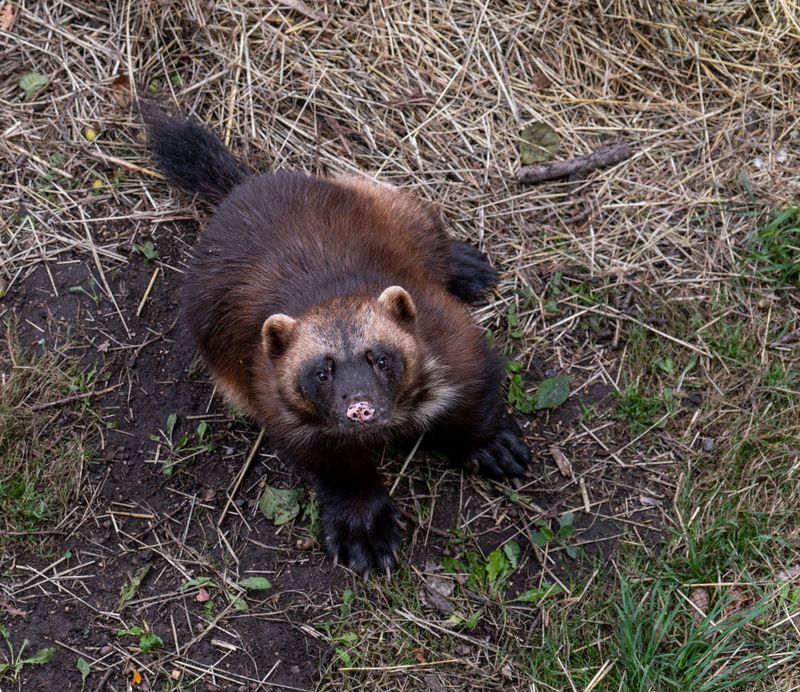
What They Look Like
Wolverines have a broad, rounded head, short legs, and a thick body built for power rather than speed. Adults typically weigh between 9 and 18 kilograms (20 to 40 pounds) and measure about 65 to 105 centimeters (26 to 41 inches) in length, not counting the bushy tail. Their dark brown fur is coarse and oily, which keeps it from absorbing water and helps the wolverine stay dry in deep snow. Most wolverines have a distinctive pale stripe that runs from each shoulder along the sides and meets near the tail, forming a shape that looks a bit like a mask or a cape. Their large, slightly curved claws are semi-retractable and serve as powerful tools for digging, climbing, and gripping icy terrain.
Strength and Stamina
Pound for pound, wolverines are among the strongest mammals on the planet. Their powerful jaws can crush frozen meat and crunch through bone, allowing them to eat carcasses that other scavengers cannot break apart. Wolverines have been known to drive wolves and even bears away from a kill, relying on their fearless attitude and sharp teeth rather than size. Their broad, snowshoe-like paws let them travel easily over deep snow, giving them an advantage over heavier animals whose legs sink with every step. A wolverine can cover 24 kilometers (15 miles) or more in a single day while searching for food, and researchers have recorded individuals climbing nearly 1,500 meters (5,000 feet) of steep mountain terrain in just 90 minutes.
Where They Live
Wolverines are found across the boreal forests, alpine meadows, and Arctic tundra of North America, Europe, and Asia. In North America, they live mainly in Alaska, western Canada, and small pockets of the northern Rocky Mountains in states like Montana, Idaho, and Wyoming. In Europe and Asia, they range across Scandinavia and northern Russia all the way to Siberia. Wolverines need vast stretches of cold, undisturbed wilderness, and a single male’s territory can cover more than 900 square kilometers (350 square miles). They tend to stay in areas where snow persists well into spring, partly because female wolverines dig their dens in deep snowpack to keep their young protected and insulated.
What They Eat
Wolverines are opportunistic feeders that will eat almost anything they come across. During winter, much of their diet comes from scavenging the remains of caribou, moose, and deer that have been killed by wolves or have died from harsh conditions. In warmer months they actively hunt smaller prey such as arctic hares, ground squirrels, marmots, and ptarmigan. They also eat berries, roots, and insect larvae when they find them. Wolverines are famous for caching food, meaning they bury extra meat in snow or wedge it into rocky crevices to eat later, effectively using the cold landscape as a natural freezer.
Scent Marking and Territory
Wolverines are largely solitary animals that communicate through scent rather than sound. They have specialized scent glands near the base of their tail that produce a strong, musky odor, which is why some people call them “skunk bears.” By rubbing their scent on trees, rocks, and food caches, wolverines leave chemical messages that tell other wolverines to stay away from their territory. A male’s home range often overlaps with the territories of two or three females, but males rarely tolerate other males nearby. Wolverines also use urine to mark the boundaries of their range, and they can detect these scent marks even under fresh snow, helping them navigate their enormous territories.
Kits and Family
Female wolverines give birth in late winter or early spring, usually to a litter of two or three babies called kits. The mother digs a den deep in the snowpack, sometimes tunneling down to a fallen log or boulder where the kits will be sheltered from predators and extreme cold. Newborn kits are covered in white fur, weigh only about 100 grams (3.5 ounces), and are completely dependent on their mother. Over the next several months, the mother nurses and protects them while gradually introducing solid food. By autumn the young wolverines begin exploring on their own, but they may stay in their mother’s territory for up to two years before setting off to establish ranges of their own.
Conservation
Wolverines face several threats that have reduced their numbers across parts of their historic range. Habitat loss from logging, road building, and expanding human settlements pushes wolverines out of the wild spaces they depend on. Climate change is an especially serious concern because wolverines rely on deep, lasting snowpack for denning, and warmer temperatures are causing snow to melt earlier each spring. Trapping for their frost-resistant fur, which is prized by Indigenous peoples for lining parka hoods, has also reduced populations in some regions. In the contiguous United States, wolverines number only about 300 individuals, and in 2024 they were listed as a threatened species under the Endangered Species Act. Conservation efforts now focus on protecting large corridors of wilderness so wolverines can travel safely between mountain ranges and maintain healthy, connected populations.
 OtterKnow Kids Encyclopedia