
Hawk moths, also called sphinx moths, are among the fastest and most powerful fliers in the insect world. There are about 1,450 species in the family Sphingidae, found on every continent except Antarctica. They are best known for their ability to hover in midair while feeding, much like hummingbirds — in fact, one common species is literally called the hummingbird hawk moth because the resemblance is so striking.
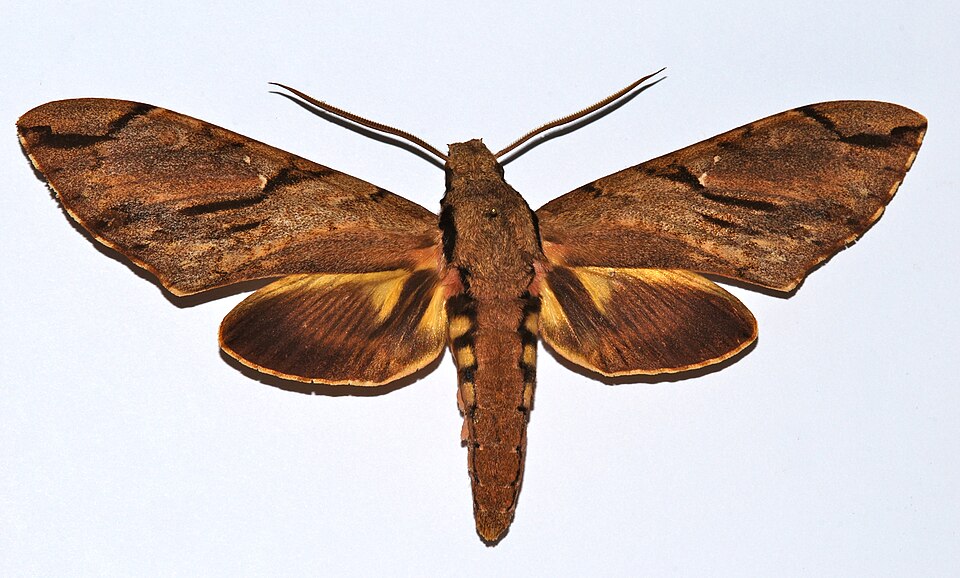
Hawk moths have streamlined, torpedo-shaped bodies built for speed. Their front wings are long and narrow, while their hind wings are shorter and often brightly colored. Most species have wingspans between 5 and 12 centimeters (2 to 5 inches), though the largest tropical species can reach up to 18 centimeters (7 inches). Their bodies are covered in thick, furry scales that help them stay warm during cool nighttime flights. Hawk moths have large compound eyes well adapted for low-light vision, which is why most species are active at dusk and after dark.
A hawk moth’s most distinctive feature is its proboscis — a long, flexible, straw-like tongue used to drink nectar from deep inside flowers. When not in use, the proboscis coils up tightly against the moth’s head, much like a watch spring or a party blower. The length varies by species — some have proboscises just a few centimeters long, while others have tongues longer than their entire body. This allows them to reach nectar hidden deep inside tubular flowers that other insects cannot access.
Hawk moths hover in front of flowers by beating their wings up to 85 times per second, creating a distinctive humming sound. While hovering, the moth unrolls its proboscis and inserts it into the flower. As it feeds, pollen grains stick to its head and body. When the moth visits the next flower, some of that pollen rubs off onto the stigma, pollinating the plant. Many flowers that depend on hawk moth pollination are white or pale colored (visible at night), have strong sweet fragrances that intensify after dark, and have deep tubular shapes that match the moth’s long proboscis.
Like all moths and butterflies, hawk moths undergo complete metamorphosis with four life stages: egg, larva (caterpillar), pupa, and adult. Hawk moth caterpillars are often large and distinctive. Many species have a horn-like spike on their tail end, which is harmless but looks intimidating. When threatened, some caterpillars rear up the front of their body in a pose that resembles the Great Sphinx of Egypt — which is how the family got the name “sphinx moth.” Some caterpillars also have large false eye spots that make them look like snakes to scare away predators.
Hawk moths are found worldwide in tropical, subtropical, and temperate regions. The greatest diversity of species lives in tropical forests, but many species thrive in gardens, farmland, and even cities. Some hawk moths are impressive long-distance migrants. The death’s-head hawk moth, famous for the skull-like marking on its thorax, migrates from Africa to Europe each summer. The convolvulus hawk moth can travel thousands of kilometers during migration.
- The tobacco hornworm, a common garden pest in North America, is actually a hawk moth caterpillar (the Carolina sphinx moth).
- Hawk moths are important pollinators for many crops and wildflowers, especially those that bloom at night.
- A hawk moth’s flight muscles must reach about 25°C (77°F) before it can fly. On cool nights, the moth vibrates its wings rapidly to warm up, a behavior called shivering thermogenesis.
- The death’s-head hawk moth can make a squeaking sound by forcing air through its proboscis. It also raids beehives to steal honey!
- Some hawk moth species can reach flight speeds of over 19 kilometers per hour (12 mph).
OtterKnow Kids Encyclopedia