What It Looked Like
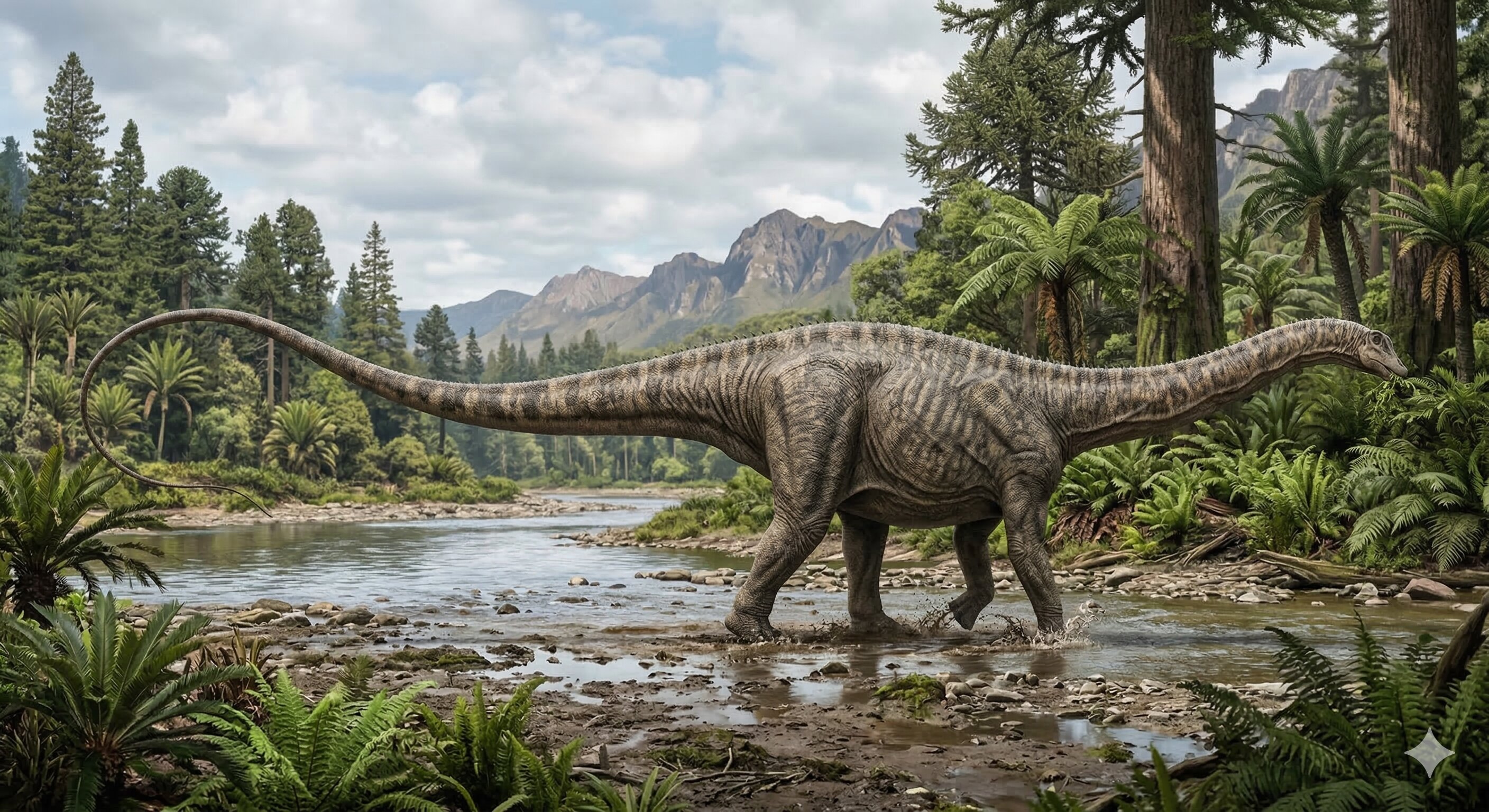
Diplodocus stretched about 26 meters (85 feet) from the tip of its snout to the end of its tail, making it one of the longest dinosaurs ever discovered. Despite this great length, it was surprisingly lightweight compared to other giant sauropods, weighing around 12 to 16 metric tons. Its body was built like a suspension bridge, with four sturdy, pillar-like legs supporting a long horizontal frame. Diplodocus had a tiny head relative to its massive body, and its nostrils sat high on the top of its skull. Its skin was likely tough and scaly, and some fossil evidence suggests it may have had a row of short spines running along its back.
The Long Neck and Tail
The neck of Diplodocus contained at least 15 vertebrae and could reach about 6 meters (20 feet) in length, allowing it to sweep across wide areas of vegetation without moving its body. Unlike what older illustrations showed, scientists now believe Diplodocus held its neck mostly horizontal rather than raised high in the air, because the shape of its vertebrae limited upward movement. Its tail was even longer than its neck, tapering to a thin, flexible tip that may have worked like a whip. Some researchers think Diplodocus could crack its tail fast enough to create a sonic boom, which might have been used to scare off predators or communicate with other members of its herd. The tail also served as a counterbalance to the long neck, helping the animal stay steady as it walked.
What It Ate
Diplodocus was a herbivore that spent most of its day eating plants to fuel its enormous body. Its teeth were thin, peg-shaped, and clustered at the front of its mouth — perfect for stripping leaves and needles off branches but not for chewing. Instead of grinding its food, Diplodocus likely swallowed plant material whole and may have used gastroliths, or stomach stones, to help break down tough vegetation in its digestive system. It probably fed on ferns, conifers, ginkgoes, and other plants that grew in its Jurassic habitat. Because it could sweep its long neck from side to side, Diplodocus could harvest a large area of low-growing plants without taking a single step.
Where It Lived
Fossils of Diplodocus have been found across several western U.S. states, including Colorado, Utah, Wyoming, and Montana. During the Late Jurassic, this region looked very different from today — it was a broad, semi-arid floodplain with rivers, seasonal wetlands, and patches of conifer forest. The climate was warm and mild, without the freezing winters we experience now in those areas. Diplodocus likely roamed these open landscapes in herds, following water sources and fresh vegetation as the seasons changed. It shared this environment with many other famous dinosaurs, including the plated Stegosaurus and the fearsome predator Allosaurus.
How We Know About It
The first Diplodocus bones were discovered in 1877 by Benjamin Mudge and Samuel Wendell Williston near Canon City, Colorado. Paleontologist Othniel Charles Marsh officially named the dinosaur in 1878, during a period of intense fossil hunting known as the Bone Wars. Since then, several nearly complete skeletons have been found, making Diplodocus one of the best-known sauropod dinosaurs in the world. In the early 1900s, the Scottish-American industrialist Andrew Carnegie funded the discovery and casting of a spectacular Diplodocus skeleton, and he sent plaster replicas to museums across Europe and South America. These casts made Diplodocus one of the most recognized dinosaurs on the planet and sparked public fascination with prehistoric life.
Almost all Diplodocus fossils come from a layer of rock called the Morrison Formation, which stretches across much of the western United States. This geological formation was laid down during the Late Jurassic and preserves one of the richest collections of dinosaur fossils anywhere in the world. Scientists have found the remains of dozens of dinosaur species in the Morrison Formation, from massive sauropods like Brontosaurus to small, agile predators. The rocks tell us that this region experienced seasonal droughts, which may have forced large herbivores like Diplodocus to migrate in search of food and water. Studying the Morrison Formation has given paleontologists a detailed picture of what life looked like 150 million years ago.
Diplodocus vs. Other Sauropods
Diplodocus belonged to a group of dinosaurs called sauropods, which were the largest land animals in Earth’s history. Compared to its close relative Apatosaurus, Diplodocus was longer but more lightly built, with a slimmer body and a longer, more whip-like tail. Another relative, Brachiosaurus, was much heavier and held its neck at a steep upward angle, while Diplodocus kept its neck lower and more horizontal. Supersaurus, also found in the Morrison Formation, may have been even longer than Diplodocus, possibly reaching over 30 meters in length. Despite their differences in size and shape, all these sauropods shared the same basic body plan — a small head, long neck, barrel-shaped body, and a long tail — a design that made them extraordinarily successful for tens of millions of years.
 OtterKnow Kids Encyclopedia