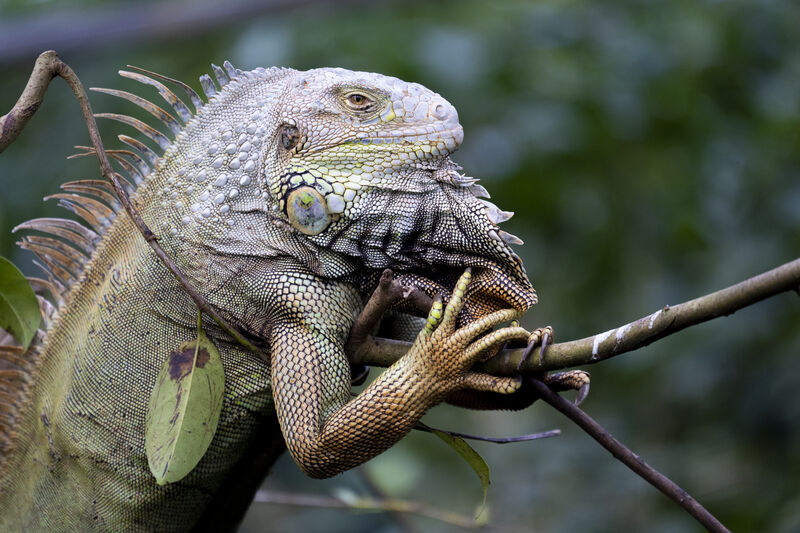
What They Look Like
Green iguanas can grow to be quite large, sometimes reaching over five feet long from nose to tail tip. Most of that length comes from their powerful tail, which they can whip at predators to defend themselves. Their skin is covered in small, rough scales, and a row of pointed spines runs down their back from the neck all the way to the tail, giving them a dragon-like appearance. Green iguanas are usually bright green when young, but their color can shift to darker shades of gray, brown, or orange as they age. Their strong claws and long toes make them excellent climbers, and they spend much of their time high up in the branches of tropical trees.
The Third Eye
One of the most unusual features of an iguana is its parietal eye, often called the “third eye.” This small, pale scale sits right on the top of the iguana’s head, between its two regular eyes. The parietal eye cannot see images or shapes the way normal eyes do, but it can detect changes in light and shadow overhead. Scientists believe this helps iguanas sense when a predator like a hawk or eagle is swooping down from above. It may also help iguanas regulate how much time they spend basking in the sun, since the parietal eye can sense the brightness and angle of sunlight.
The Dewlap
If you look underneath an iguana’s chin, you will notice a large flap of skin called a dewlap. Iguanas extend their dewlap by pushing it outward with a flexible piece of cartilage, almost like opening a fan. Male iguanas use this display to communicate with other iguanas — a fully spread dewlap can signal dominance, warn rivals to stay away, or attract a mate during breeding season. Females have dewlaps too, but they are usually smaller and less colorful. The dewlap also helps iguanas regulate their body temperature by increasing the surface area of skin exposed to the air.
What They Eat
Green iguanas are herbivores, which means they eat only plants. Their diet consists mainly of leaves, flowers, and fruit from the trees and shrubs in their tropical habitat. Young iguanas sometimes eat insects or other small invertebrates, but as they grow older they switch almost entirely to a plant-based diet. Iguanas have small, serrated teeth along the edges of their jaws that are perfectly shaped for tearing and shredding tough leaves. They do not chew their food very much — instead, they rip off pieces and swallow them mostly whole, relying on their digestive system to break everything down.
Thermoregulation
Like all reptiles, iguanas are ectothermic, meaning they cannot produce their own body heat the way mammals do. Instead, they depend on their environment to warm up and cool down — a process called thermoregulation. Each morning, iguanas crawl out to an open branch or rock and bask in the sunlight until their body reaches the right temperature for activity, usually around 85 to 95 degrees Fahrenheit. If they get too hot, they move into the shade or retreat to a cooler spot among the leaves. This careful balancing act between sun and shade is essential for their digestion, muscle movement, and overall health.
The Marine Iguana
While most iguanas live in trees, the marine iguana of the Galápagos Islands has taken a completely different path. Marine iguanas are the only lizards in the world that swim and feed in the ocean, diving beneath the waves to scrape algae off underwater rocks. Their flattened tails work like rudders, and their blunt snouts are specially shaped for gripping slippery rock surfaces. After a cold swim in the Pacific, marine iguanas crowd together on dark volcanic rocks to soak up the sun and raise their body temperature back to normal. Charles Darwin observed these remarkable animals during his famous voyage on the HMS Beagle in the 1830s, and they played an important role in shaping his ideas about evolution and adaptation.
Iguanas and People
In many parts of Latin America, iguanas have been an important part of human culture for centuries. Some communities have traditionally hunted iguanas for food, and iguana meat is still considered a delicacy in parts of Mexico and Central America. Green iguanas have also become popular pets around the world, though they require specialized care, large enclosures, and a proper diet to stay healthy. Unfortunately, habitat loss from deforestation and urban development threatens wild iguana populations in many regions. Conservation programs in several countries are now working to protect iguana habitats and breed endangered species, helping to ensure that these ancient-looking reptiles continue to thrive in the wild.
 OtterKnow Kids Encyclopedia