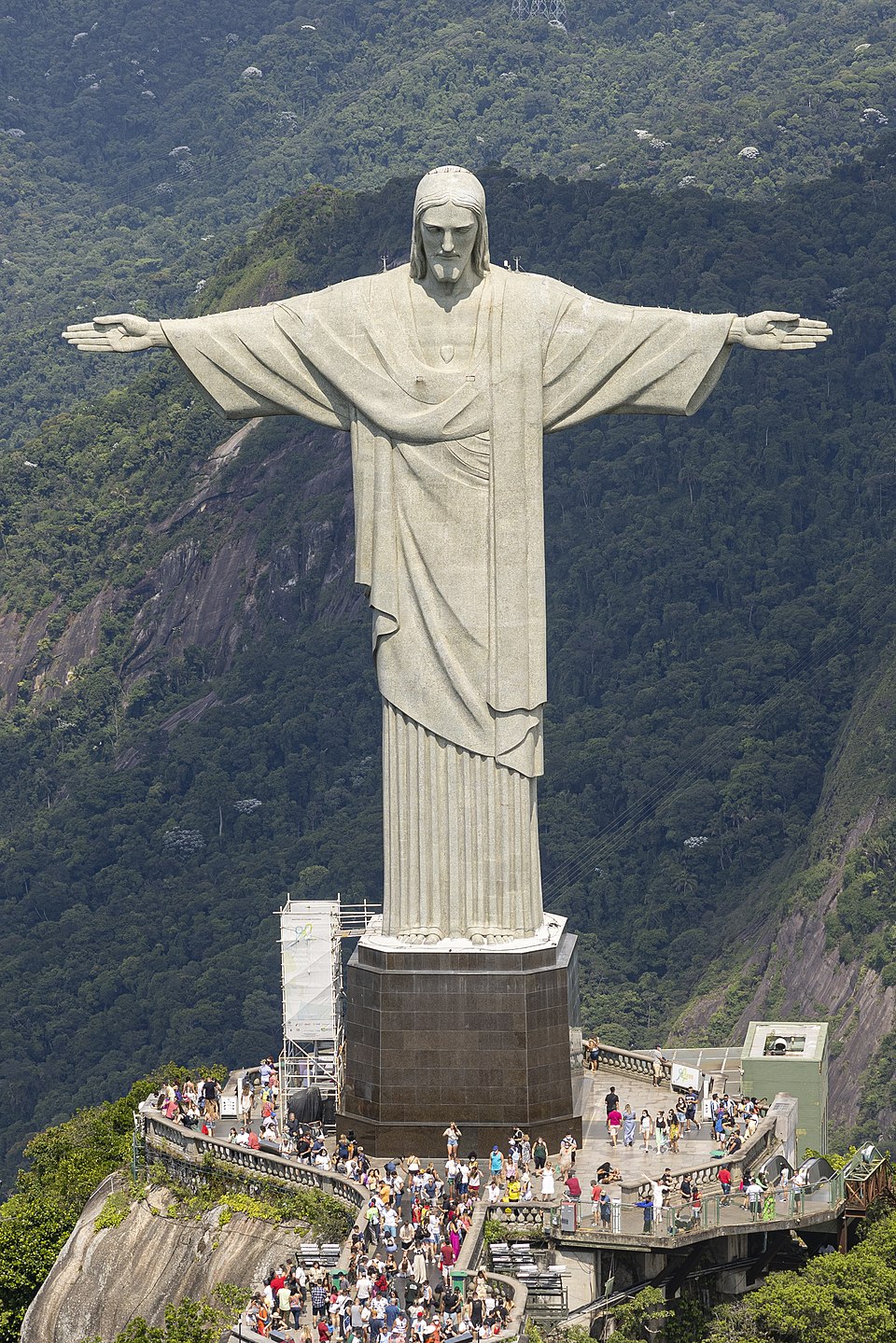
Christ the Redeemer
The statue of Christ the Redeemer is Rio’s most iconic landmark and one of the New Seven Wonders of the World. Standing 38 meters tall with arms stretched wide, the statue sits atop Corcovado Mountain, about 700 meters above the city. It was completed in 1931 and is made of reinforced concrete covered in thousands of triangular soapstone tiles. On clear days, the statue can be seen from almost anywhere in Rio, and visitors can take a train up the mountain for sweeping views. Christ the Redeemer has become a symbol not just of Rio but of all of Brazil.
Sugarloaf Mountain and Natural Beauty
Sugarloaf Mountain, called Pão de Açúcar in Portuguese, is a towering granite peak that rises 396 meters above the harbor at the entrance to Guanabara Bay. Visitors ride a cable car in two stages to reach the summit, where they can see the entire city spread out below. Rio is also surrounded by Tijuca Forest, one of the largest urban forests in the world, which is home to hundreds of species of plants and animals. The combination of mountains, ocean, and tropical forest gives Rio a landscape unlike any other major city. In 2012, UNESCO recognized parts of Rio’s landscape as a World Heritage Site.
Famous Beaches
Rio de Janeiro is famous for its long, sandy beaches that line the Atlantic coast. Copacabana Beach stretches for about four kilometers and is one of the most well-known beaches on Earth, packed with sunbathers, swimmers, and soccer players. Just south of Copacabana lies Ipanema Beach, made famous by the classic bossa nova song from the 1960s. Brazilians treat their beaches as outdoor living rooms, gathering with friends and family to play sports, eat snacks from vendors, and enjoy the sunshine. The beaches are an important part of daily life in Rio, not just a tourist attraction.
Carnival
The Rio Carnival is the largest carnival celebration in the world, drawing about two million people to the streets each day during the festivities. Held every year before the Christian season of Lent, Carnival features elaborate parades, dazzling costumes, and nonstop music and dancing. The highlight is the Samba Parade, where samba schools from different neighborhoods compete with spectacular floats and choreographed performances in a giant stadium called the Sambadrome. Samba music itself developed in Rio’s hillside communities, known as favelas, blending African rhythms brought by enslaved people with Brazilian musical traditions. Carnival is a celebration of creativity, community, and the rich cultural diversity of Brazil.
History and Capital
Rio de Janeiro has played a central role in Brazilian history for centuries. When the Portuguese royal family fled Europe during the Napoleonic Wars in 1808, they made Rio the capital of the entire Portuguese Empire. Rio remained the capital of Brazil even after the country gained independence in 1822 and continued in that role until 1960, when the new planned city of Brasília took over as the national capital. The city also hosted the 2014 FIFA World Cup and the 2016 Summer Olympics, becoming the first South American city to hold the Olympic Games. These events brought worldwide attention to Rio and led to major improvements in the city’s transportation and sports facilities.
Music and Culture
Rio de Janeiro is the birthplace of several music styles that are loved around the world. Samba, with its infectious rhythms and energetic dancing, originated in Rio’s favelas in the early 1900s. Bossa nova, a smoother and jazzier style, also emerged from Rio in the late 1950s and became popular internationally. Beyond music, Rio has a thriving arts scene with museums, street art, theaters, and film festivals. The city’s culture reflects a blend of Indigenous, African, and European influences that have mixed together over hundreds of years.
Geography and Climate
Rio de Janeiro is located on the southeastern coast of Brazil, where the mountains of the Serra do Mar meet the Atlantic Ocean. The city enjoys a tropical climate with warm temperatures year-round, averaging about 26 degrees Celsius in summer and 21 degrees in winter. Guanabara Bay, one of the largest bays in the world, forms Rio’s eastern shoreline and is dotted with small islands. The dramatic contrast between steep, forested mountains and flat coastal plains gives Rio its unforgettable skyline. From any angle, Rio de Janeiro is one of the most beautiful cities on the planet.
 OtterKnow Kids Encyclopedia