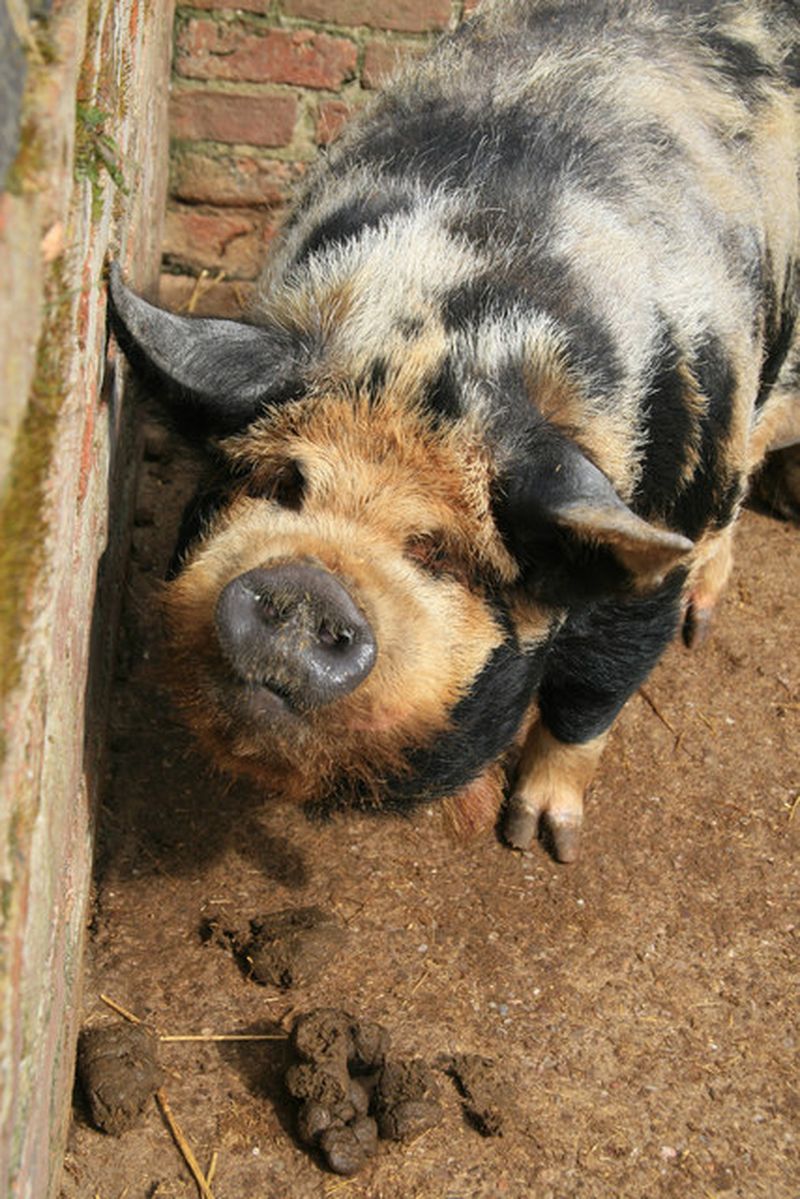
What They Look Like
Domestic pigs come in a wide variety of sizes, colors, and body shapes depending on their breed. Some breeds, like the Large White, can weigh over 300 kilograms (660 pounds), while miniature breeds may weigh as little as 35 kilograms (77 pounds). Most pigs have stout, barrel-shaped bodies with short legs, flat snouts, and small curly tails. Their skin can be pink, black, brown, spotted, or even belted with stripes of different colors. Pigs have coarse hair called bristles rather than soft fur, and their tough snouts are packed with nerve endings that make them incredibly sensitive.
Highly Intelligent Animals
Scientists consider pigs to be the fourth most intelligent animal in the world, behind chimpanzees, dolphins, and elephants. They can learn tricks, solve puzzles, and even play simple video games using joysticks with their snouts. In experiments, pigs have shown the ability to recognize themselves in mirrors, a sign of self-awareness that very few animals demonstrate. They also have excellent long-term memories and can remember specific locations, other pigs, and people they have met years earlier. Pigs are social animals that form close bonds with one another, and researchers have found that they can sense the emotions of other pigs, showing a kind of empathy.
An Amazing Sense of Smell
A pig’s sense of smell is one of the most powerful in the animal kingdom. Their large, flat snouts contain far more scent receptors than a human nose, allowing them to detect odors buried deep underground. For centuries, people in Europe have used pigs to hunt for truffles, rare and valuable fungi that grow beneath the roots of certain trees. Pigs can sniff out truffles buried up to 30 centimeters (about a foot) below the surface. Their keen noses have also been trained to detect landmines, drugs, and even certain diseases, making pigs surprisingly useful partners for humans.
Why They Roll in Mud
You may have heard the saying “sweating like a pig,” but this is actually a myth because pigs cannot sweat. Unlike humans and many other mammals, pigs have very few sweat glands, which means they cannot cool themselves down by perspiring. Instead, they roll around in mud to lower their body temperature on hot days. The layer of mud that dries on their skin also acts as a natural sunscreen, protecting them from painful sunburns and pesky biting insects. When given a clean environment with a shady spot or a pool of water, pigs will actually keep themselves quite tidy and prefer not to soil the area where they sleep and eat.
History and Domestication
Humans first domesticated pigs from wild boars roughly 10,000 years ago, making pigs one of the earliest domesticated animals. This happened independently in at least two places: the Near East (modern-day Turkey and surrounding areas) and China. Early farmers valued pigs because they grow quickly, produce large litters of piglets, and can eat a wide variety of foods, from grains and vegetables to scraps and leftovers. Over thousands of years, selective breeding produced the many different pig breeds we see today, each developed for specific traits like size, temperament, or meat quality. Ancient civilizations including the Romans, Egyptians, and Chinese all raised pigs as an important source of food.
Wild Boars and Domestic Pigs
Wild boars are the ancestors of all domestic pigs, and they still roam forests and grasslands across Europe, Asia, and parts of North Africa. They are stockier and hairier than farm pigs, with dark bristly coats, long sharp tusks, and powerful shoulders built for rooting through tough ground. Wild boars are excellent swimmers, fast runners that can reach speeds of 40 kilometers per hour (25 miles per hour), and surprisingly fierce when threatened. When domestic pigs escape into the wild, they can quickly revert to a more boar-like appearance within just a few generations, growing thicker hair and longer tusks. Feral pig populations have become a serious problem in parts of the United States, Australia, and other regions, where they damage crops and compete with native wildlife.
Pigs Around the World
Pigs are raised on farms in nearly every country and are one of the most widely consumed animals in the world. China raises more pigs than any other nation, with a herd of hundreds of millions. In Spain, a special breed of black pig called the Iberian pig roams oak forests eating acorns, producing some of the most prized ham in the world. Different cultures have very different relationships with pigs: while many societies consider pork a staple food, some religious traditions, including Islam and Judaism, do not eat pork at all. In some Pacific Island cultures, pigs hold deep ceremonial importance and are considered a sign of wealth and status.
Pigs and People
Beyond farming, pigs have become important to humans in many unexpected ways. Because pig organs are similar in size and structure to human organs, medical researchers are studying pig-to-human organ transplants, a field called xenotransplantation. Pigs have also become popular pets in some parts of the world, with breeds like the Vietnamese potbellied pig kept in homes much like dogs. Their intelligence, curiosity, and social nature make them engaging companions. Whether on the farm, in the forest hunting truffles, or in a research laboratory helping advance medicine, pigs continue to be one of the most important animals in human history.
 OtterKnow Kids Encyclopedia